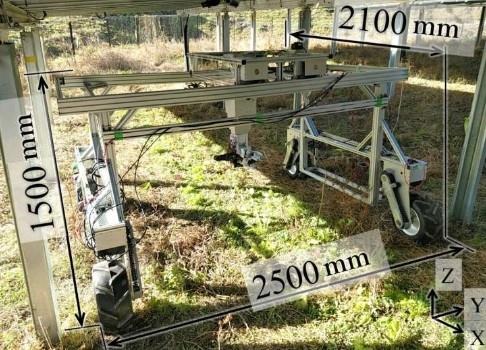
Researchers have developed a small and flexible agricultural robot for Synecoculture farming. It has a four-wheel mechanism, two axes stand, robotic arm, camera unit, maneuvering system, and farming tools.
Synecoculture is a new agricultural method advocated by Dr. Masatoshi Funabashi, senior researcher at Sony Computer Science Laboratories, Inc. (Sony CSL), in which various kinds of plants are mixed and grown in high density, establishing rich biodiversity while benefiting from the self-organizing ability of the ecosystem.
However, such dense vegetation requires frequent upkeep—seeds need to be sown, weeds need to be pruned, and crops need to be harvested. Synecoculture thus requires a high level of ecological literacy and complex decision-making.
And while the operational issues present with Synecoculture can be addressed by using an agricultural robot, most existing robots can only automate one of the above three tasks in a simple farmland environment, thus falling short of the literacy and decision-making skills required of them to perform Synecoculture. Moreover, the robots may make unnecessary contact with the plants and damage them, affecting their growth and the harvest.
With the rising awareness of environmental issues, such a gap between the performance of humans versus that of conventional robots has spurred innovation to improve the latter. A group of researchers led by Takuya Otani, an Assistant Professor at Waseda University, in collaboration with Sustainergy Company and Sony CSL, have designed a new robot that can perform Synecoculture effectively. The robot is called SynRobo, with "syn" conveying the meaning of "together with" humans.
It manages a variety of mixed plants grown in the shade of solar panels, an otherwise unutilized space. An article describing their research was published in Agriculture. This article has been co-authored by Professor Atsuo Takanishi, also from Waseda University, other researchers of Sony CSL, and students from Waseda University.
Otani briefly explains the novel robot's design. "It has a four-wheel mechanism that enables movement on uneven land and a robotic arm that expands and contracts to help overcome obstacles. The robot can move on slopes and avoid small steps. The system also utilizes a 360o camera to recognize and maneuver its surroundings. In addition, it is loaded with various farming tools—anchors (for punching holes), pruning scissors, and harvesting setups. The robot adjusts its position using the robotic arm and an orthogonal axes table that can move horizontally."
Besides these inherent features, the researchers also invented techniques for efficient seeding. They coated seeds from different plants with soil to make equally-sized balls. These made their shape and size consistent, so that the robot could easily sow seeds from multiple plants. Furthermore, an easy-to-use, human-controlled maneuvering system was developed to facilitate the robot's functionality. The system helps it operate tools, implement automatic sowing, and switch tasks.
Click here to see more...