By Ashley Dean and Dr. Erin Hodgson
Adult alfalfa weevils become active and start laying eggs as soon as temperatures exceed 48°F. Like other insects, the development of alfalfa weevil depends on temperature, and we can use accumulation of growing degree days (GDD) to predict activity. Alfalfa weevil egg hatching begins when 200-300 GDD (base 48°F) have accumulated since January 1.
Based on accumulated temperatures since January, alfalfa weevils may be active in the southern half of the state (Figure 1). In Iowa, fields south of Interstate 80 should be scouted beginning at 200 GDD and fields north of Interstate 80 should be scouted beginning at 250 degree days. Areas in northern Iowa have lower GDD accumulation and may not see activity yet, but with forecasted temperatures we could see activity by the end of April.
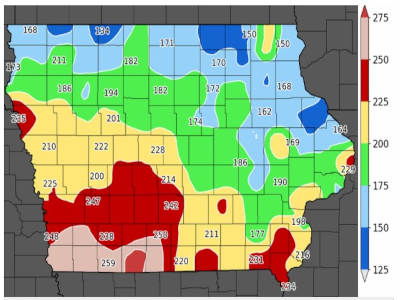
Figure 1. Accumulated growing degree days (base 48°F) in Iowa from January 1 – April 8, 2021.
Biology
Alfalfa weevil is an important defoliating pest in alfalfa. Heavy infestations can reduce tonnage and forage quality. Alfalfa weevil larvae typically cause the majority of plant injury. Newly hatched larvae can be found feeding on terminal leaves, leaving newly expanded leaves skeletonized. Maturing larvae (Photo 1) move down the plant and begin feeding between leaf veins. Peak larval activity occurs around 575 GDD. Silken pupal cases are often attached to leaves in the lower canopy or in leaf litter.
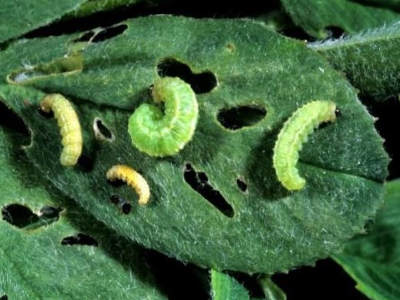
Photo 1. Mature alfalfa weevil larvae have a dark head and pale green body with a white stripe down the back. Fully-grown larvae are about 5/16 inches long.
The time it takes to reach the adult stage is dependent on temperature but is usually around eight weeks. Adults (Photo 2) cause less plant injury than larvae. They feed along the leaf margin, leaving irregular notches. Female alfalfa weevils can lay 800-4,000 eggs in a lifetime and insert 5-20 eggs at a time into alfalfa stems. A heavily infested field will look frosted or silver (Photo 3).
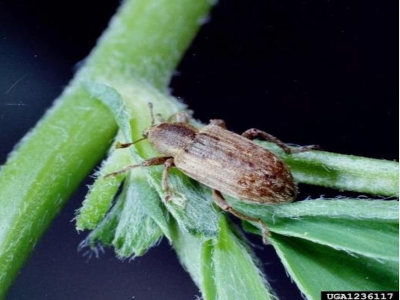
Photo 2. Alfalfa weevil adults have an elongated snout and elbowed antennae. Their wings and body are mottled or brown.
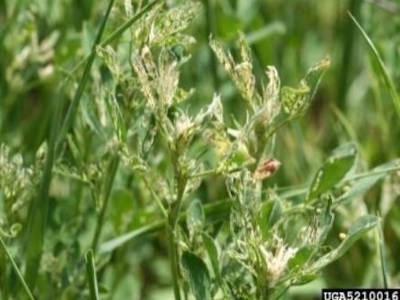
Photo 3. Heavily-defoliated alfalfa fields appear frosted from a distance.
Scouting and Management
After reaching benchmark degree days (200 in southern Iowa and 250 in northern Iowa), use a sweep net to sample for adults and larvae. South-facing slopes warm up faster and may be a place to start sampling. Once the first larvae are collected in your sweep net, you need to know four pieces of information to decide if the economic threshold has been reached in that field:
- Market value of the hay ($/ton).
- Control costs ($/acre).
- Plant height (inches).
- Number of larvae.
The last two pieces of the economic threshold determination can be gathered by scouting the field. Collect six alfalfa stems from 5 random locations throughout the field (total of 30 stems) by breaking them off at the base, making sure to be gentle so as not to lose larvae during the process. Measure the height of these plants. Most of the larvae can be dislodged by vigorously shaking the stems into a bucket. Small larvae can be difficult to separate from the plant, so the plants should also be carefully inspected after shaking. Take the average plant height and count the total number of larvae per 30 stems, then use Table 1 to determine if an insecticide application is warranted.
Cutting alfalfa is an effective management tool for alfalfa weevil larvae, and an insecticide application may be avoided if harvesting occurs within a few days of reaching the economic threshold. Harvesting is preferred to chemical treatments once plants are 16 inches tall.
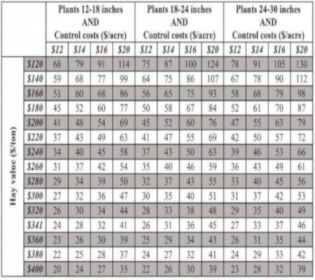
Table 1. Economic threshold of alfalfa weevil, based on the total number of larvae in a 30-stem sample
Source : iastate.edu