By Stan Smith and Chris Penrose
With fertilizer prices on the rise and reaching levels not seen in years, some are wondering if they can afford to fertilize hay ground. Realizing we can’t starve a profit into a cow, or a hay crop, the answer is simple. We can’t afford not to properly and strategically fertilize a hay crop.
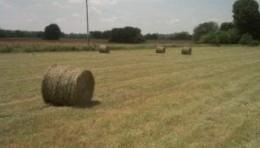
While you can’t starve profit into a hay field, there may be some options.
The operative word here is “strategically.” Let’s look at what that word might mean in the coming 2022 hay season.
First and foremost, now more than ever is the time to make sure we have up to date soil tests. We can’t manage what we haven’t measured and knowing the nutrient content of forage fields is critical to knowing which soil nutrients will offer the most return on investment.
Lime has gone up little if any, in price, in recent years. To optimize the efficiency of the fertility we do have, correcting soil pH should be high priority during times of expensive soil nutrients.
Don’t just spread manure on the most conveniently located field. Apply it where the soil test indicates it’s most needed. Not sure what the nutrient content of your manure is? Perhaps having your manure analyzed for nutrient content this year might be dollars well spent.
What kind of hay are you growing . . . grass or legume? If it’s a field full of legume or field heavily mixed with legume, nitrogen is likely not needed at all. On the other hand, if the goal is to optimize the productivity of stands that are predominantly grass, yields will be benefited by properly timing the application of a correct amount and source of nitrogen.
Strategically timing nitrogen might mean foregoing an early spring application since it’s not uncommon to grow more first cutting hay than we can make and harvest in a timely fashion. However, 50 units of nitrogen applied to a grass hay field immediately after first or second cutting can significantly boost yield of the subsequent cutting.
Applying nitrogen after a first cutting onto warm soils at times of high air temperatures increases the risk of volatilization of urea-based nitrogen sources. Use a stable source of nitrogen such as ammonium sulfate. If using urea and rainfall is not on the horizon, including a nitrogen stabilizer or urease inhibitor is likely warranted. If phosphorus is being applied at the same time, the nitrogen that comes along with a phosphorus source like 18-46-0 is stable and effective.
Perhaps the most difficult decision will be what to do about phosphorus and potash needs. Each ton of harvested hay removes with it 12 pounds of P2O5 phosphorus and 49 pounds of K2O potash. If soil nutrient levels of phosphorus and potash are at critical minimum levels, perhaps the only phosphorus and potash that needs to be applied this year are the amounts removed through harvest. If levels are at the minimum critical levels of 30 ppm for phosphorus when using the Mehlich-3 extraction method, and 120 ppm for potash on loam and clay soils, phosphorus and potash could wait to be replaced at the end of next growing season if you are of the opinion fertilizer prices may moderate before then.
If soil test results indicate phosphorus and potash levels are above the minimum critical level mentioned above for forages, it may be cost effective to skip a year of phosphorus and potash application. Regardless, now may not be the best time to proceed with an aggressive soil nutrient build up program.
And, if you do choose to replace all the phosphorus and potash removed by a hay crop, how much will that cost per ton of hay removed? Using crop removal rates suggested earlier and when assuming phosphorus and potash cost near 60 cents per pound, a ton of forage is removing from the field between $35 and $40 dollars’ worth of fertility. If it’s predominantly grass hay and you add 20 units of N per ton of hay produced, at today’s fertilizer prices you’ll add about $15 to that total.
If you value hay at $100 or more per ton and harvesting optimum yields of high-quality hay is essential to the success of your operation, fertilization, even despite very high soil nutrient cost becomes a no brainer. You can’t starve profit into a cow, or a hay field!
Source : osu.edu