By Dominic Reisig
Fall armyworm is a sporadic outbreak pest that doesn’t overwinter in North Carolina. Populations migrate here as early as May, but really crank up as the summer progresses. We often find fall armyworm in late-planted non-Bt corn. This year they are widespread in grass, hay, and food-plots (duck impoundments planted to millet, for example).
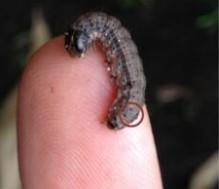
Fall armyworm has four black dots in a square at the back of the body
We have also had some serious issues in soybeans, which is unusual.
Fall armyworm has two strains- the rice/grass strain, which prefers grasses, and the corn strain, which prefers corn and soybeans. The last year we have had the corn strain widespread in soybeans was 2011. This year (2021), we have had at least two soybean fields in North Carolina that have been completely defoliated. Both of these fields were near wildlife refuges toward the coast and were late-planted or double-cropped. Likely these were grass strain fall armyworms that developed on grasses (weeds and volunteer wheat), consumed the grass, and moved into the soybeans. In the past, the grass strain has been easily controlled with pyrethroids. However, this year in the Midsouth, pyrethroids have provided poor control. Pyrethroids do not work well for the corn strain.
All soybeans should be carefully scouted for pests throughout the growing season. Pay special attention to double-cropped beans and check for fall armyworms that might be targeting volunteer wheat or weeds. Use a sweep net and pay attention to fields where you are catching more than 5 in 15 sweeps or where defoliation is happening. To be on the safe side, assume that pyrethroid control will be poor and use a caterpillar-specific insecticide. The following are cost-effective options that have worked in the Midsouth:
- Intrepid at 4oz (advantage- good residual)
- Diamond at 6oz (advantage- good residual)
- Dimilin at 4oz (use only if larvae are small since it takes time to work)
- Orthene at 0.5 to 0.75lbs (advantage- will pick up other non-caterpillar pests; disadvantage- can flare pests behind the spray such as soybean looper)
Control will be better on smaller larvae, especially since many of these insecticides are insect growth regulators. These insecticides can be tank mixed to capitalize on some of their advantages.
If fall armyworms have already started to cause defoliation in your soybean crop, you may be wondering how much defoliation you can tolerate without irreversible yield damage. The ability of your soybeans to recover depends on both the soybean growth stage and the severity of defoliation. Soybeans are more sensitive to defoliation in the reproductive than vegetative stages. At full-season planting dates, soybeans in the vegetative growth stage can withstand 60% node removal before yield loss begins to occur but only 20% in the early reproductive growth stages (Conley et al., 2009). However, while soybeans can typically withstand considerable defoliation in the vegetative growth stages before yield loss begins, previous research indicates that soybeans are more susceptible to yield loss from defoliation as planting date is delayed (Thrash et al., 2021). The North Carolina double crop fields affected so far in 2021 will have limited ability to recover from defoliation because flowering will occur soon limiting subsequent vegetative growth, especially in determinate varieties. Field of vegetative-stage soybean defoliated from fall armyworm
Field of vegetative-stage soybean defoliated from fall armyworm
Source : ncsu.edu