South Dakota (SD) grasslands continue to face dry conditions as illustrated in the mid-April SD Grassland Productivity Map on the (SD) Natural Resources Conservation Service (NRCS) website under Range and Pasture. Product of the SD Drought Tool, these maps utilize a two-year weighted average of precipitation data to determine a percent of normal production calculation incorporating historical clipping data from across the state. Forage maps relate to grassland forage production and not cropland as the maps will not predict forage quality.
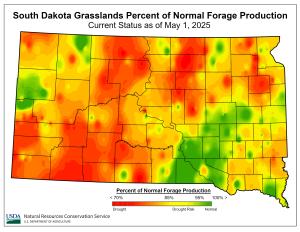
State Rangeland Specialist, Emily Rohrer, shares expertise stating, “As we enter into May, consider various strategies to reduce stress not only to grassland plants, but the livestock and wildlife by scheduling adequate rest periods to allow plants to recover after grazing events. Consider speeding up your rotation, combining herds, or utilizing alternative forages (make sure to test forages prior to turnout for nitrate accumulation)."
There are several upcoming opportunities to learn more about the strategies you can take to improve grazing quality on your operation – even during a dry period. Consider attending the Young Adult Ranching for Profit Workshop to be held in Faith, SD, June 2-5 (ages 18-30), SD Rangeland and Soils Days in Belle Fourche, SD, June 10-11 (ages 8-18), or one of the three SD Grassland Coalition’s Grazing Schools, the first event is in Wall, SD, June 17-19.
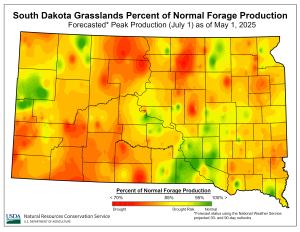
NRCS conservationist, South Dakota State University extension specialist, or consider asking a mentor through the SD Soil Health Coalition’s mentoring app: Growing Connections or seek out the SD Grassland Coalition’s mentoring network.
The following resources are also available:
SD NRCS Range and Drought page: bit.ly/Range_Pasture
South Dakota Grassland Coalition Drought Planning website: sddroughtplan.org/
National Drought Mitigation Center: drought.unl.edu/ranchplan/Monitor.aspx
National Integrated Drought Information System: drought.gov/
U.S. Drought Monitor: droughtmonitor.unl.edu
South Dakota State University Extension Drought Resources: extension.sdstate.edu/drought
SD Growing Resilience Web page: www.growingresiliencesd.com
SD Grazing Exchange: www.sdgrazingexchange.com/
Source : usda.gov