By Steven A. Fennimore
Small acreage Brassica vegetables need additional herbicide options. Among the vegetables grown in California are a number of niche crops such as Bok choi and Brussels sprouts that have a limited number of registered herbicides such as DCPA. Sulfentrazone and S-metolachlor have food use tolerances for use on Brassica head and stem group 5-16, which includes crops such as Bok choi and Brussels sprouts as well as Brassica leafy greens subgroup 4-16B, which includes crops such as kale. However, there is a lack of data for sulfentrazone and S-metolachlor on a wide variety of seeded and transplanted Brassica vegetables.
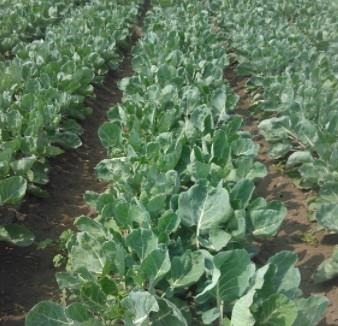
Brussels sprouts (photo: John Rachuy)
Crop tolerance field studies were conducted in 2019 and repeated in 2020 at the Hartnell research farm at Salinas, CA, S-metolachlor was applied PRE-at 0.37, 0.56 and 0.73 kg ha-1 and the standard DCPA was applied PRE-at 8.41 kg ha-1 on direct seeded bok choi, broccoli raab, collards, mizuna, mustard greens and radish, as well as transplanted Brussels sprouts and kale. The transplanted brussels sprouts and kale were also treated with sulfentrazone PRE-at 0.08 and 0.11 kg ha-1. All herbicides were applied with a CO2 backpack sprayer. After planting, the trial was sprinkler irrigated for 2 hours to set transplants and germinate seed. The plots were cultivated and hand weeded as needed to minimize weed competition., fertilized with 330 kg ha-1 21-0-0-24 (S), and sprinkler irrigated twice weekly until emergence, then once per week until harvest.
Treatments were replicated 4 times and arranged in a randomized complete block design. Data collected were crop injury estimates, and yield as well as weed control. Crops were harvested at commercial maturity typical for the Salinas Valley. Data were subjected to analysis of variance and mean separation was performed using Fisher's protected LSD's. Agriculture Research Management (ARM) 7, Version 7.0.5, Gyllings Data Management, Inc., 405 Martin Blvd., Brookings, SD 57006 was used for data analysis.
Results of this work indicate that expansion of labelled crops for S-metolachlor should include direct seeded bok choi, collards, mizuna. radish and mustard greens as well as transplanted brussels Sprouts and kale. We also recommend that sulfentrazone be labelled for use on transplanted brussels sprouts and kale.
Source : ucanr.edu