Marestail or horseweed (Erigeron canadensis) is a challenging weed to manage in no-till or minimum till soybeans systems. This weed is classified as a winter annual, but it germinates well into spring and summer making it even more difficult to manage. In addition to an extended germination window, marestail can produce an up to 200,000 seeds/plant with approximately 80% of those seeds being able to germinate immediately after maturation. Seeds can germinate on the soil surface, which is why this weed is so troublesome in minimum tillage operations. Kansas producers also face the added difficulty of trying manage glyphosate-resistant (GR) marestail. Due to the extended germination window of marestail, it is important to scout for and control marestail in both the fall and spring (Figure 1).
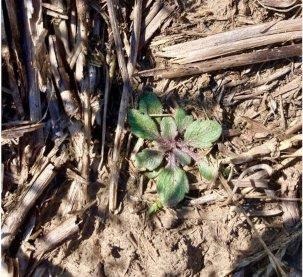
Figure 1. Fall-emerged marestail in the rosette stage in wheat stubble in Manhattan, KS. Photo by Tyler Meyeres, K-State Research and Extension.
Fall-emerged marestail can be difficult to control if allowed to grow until planting in the following spring. Acceptable control of fall-emerged marestail with herbicide applications at planting will be unlikely because the marestail are generally too large. Control can be achieved with both fall and early spring herbicide applications, but due to inconsistent weather conditions it may be advantageous to opt for a fall application. Other control options include tillage and cover crops.
Herbicides
Glyphosate resistance adds another layer of complexity to managing marestail. It is generally recommended to include group 4 herbicides such as 2,4-D, dicamba, fluroxypyr (Starane Ultra) or haluxifen (Elevore) in a tank mix to control GR marestail. Control of marestail in the rosette stage (Figure 1) is similar among the Group 4 herbicides, but dicamba controls bolted marestail better than 2,4-D. Glufosinate (Liberty, others) applied at 32 fl oz/ac Liberty can control of bolted marestail.
Residual herbicides in fall applications may be beneficial if there has been a history of marestail infestation in a field. Effective residual herbicides include: chlorimuron (Classic, others), flumioxazin (Valor, others), sulfentrazone (Spartan, others), and metribuzin products. Saflufenacil (Sharpen) is also effective in controlling marestail as a part of fall or spring burndown but has no residual activity. In addition to GR marestail, there are also confirmed populations of ALS-resistant marestail in Kansas, which may reduce the utility of ALS herbicides for controlling marestail. It is important to consider rotation restrictions with some of these herbicides.
Tillage
Fall and spring tillage has been shown to be effective in controlling marestail for a spring-planted crop. When tillage is not utilized in the fall, marestail will establish and be present in the spring. If implementing a minimum tillage system is the goal, marestail can be controlled when a fall herbicide application is followed by shallow tillage in the spring or vice versa (Chahlal and Jhala 2019).
Cover Crops
Utilizing cover crops can result in fewer and smaller marestail plants in a field. Research in Kansas has shown complete suppression of marestail with a cereal rye cover crop paired with spring herbicide applications (McCall 2018). This strategy is especially important for producers struggling with herbicide-resistant marestail populations, as it will reduce the selection pressure on the herbicides. The key to achieving effective suppression of marestail with cover crops is early planting. Early planting allows the cover crop to emerge and produce high amounts of biomass before marestail emergence.
Source : ksu.edu