By Erin Hodgson
Following up on Meaghan’s blog post on October 5 about sap beetles in corn grain, I received a few more questions about infested bins. There are MANY insects that cause losses in stored grain and food processing facilities. Complete eradication is difficult to achieve, and therefore defining acceptable limits is a more practical way to manage pests after harvest. Developing post-harvest plans can greatly improve the effectiveness and profitability for farmers and maintain a safe food supply.
Obviously, farmers do not want insects in storage bins because they can greatly impact grain quantity and quality. Depending on the species, they can feed on whole or broken kernels and eventually cause a loss of volume. Hot and humid grain bins, in addition to damaged kernels, can favor the growth of molds and mycotoxins. The breakdown of seed quality in long-term storage can greatly reduce the marketability. Also, grain contaminated with insect fragments are of concern for milling and processing plants.
Dr. Edmond Bonjour at Oklahoma State University has an extension program in stored grain IPM. There are several prophylactic and rescue treatments available for stored grain pests. IPM guidelines for stored grain pest management include:
- Start with a clean bin or silo.
- Repair leaks and openings to limit entry before storing new grain.
- Avoid mixing old (infested) grain with new grain.
- Monitor grain temperature and moisture.
- Sample regularly for pests (directly and indirectly via traps)
- Use sampling information to make treatment decisions.
- Prioritize monitoring bins with broken or diseased grain.
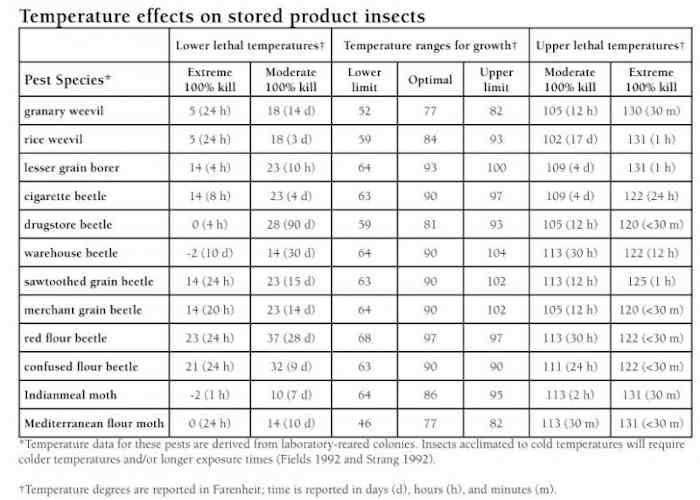
I want to focus on the effects of temperature for stored grain pests. Every insect has a lower lethal and upper lethal limit, it can get too cold or too hot to survive. Use cooling aeration to slow down development and/or kill pests is an effective strategy. Dr. Bonjour put together a table of temperature effects for several common beetles and moths:
Source : iastate.edu