By Jose Dubeux and Luana Queiroz et.al
Weed encroachment in grasslands results in large economic losses to livestock enterprises. Weeds compete for water, light, and nutrients, and reduce forage productivity. Spiny weeds irritate animals and prevent uniform grazing, reduce forage intake, and decrease livestock gains (Figure 1 below). Furthermore, weed encroachment reduces land productivity, and livestock can rapidly spread weed seeds further increasing the infestation. Controlling weed infestations, therefore, is key to achieve greater livestock performance and maintain/increase the land productivity. Management strategies are important to control different weed species, including the herbicide product, rate, and timing of application. There are numerous extension articles available for that, with detailed information (Sellers and Devkota, 2020). This article will focus, however, on potential productive losses from livestock due to weed encroachment.
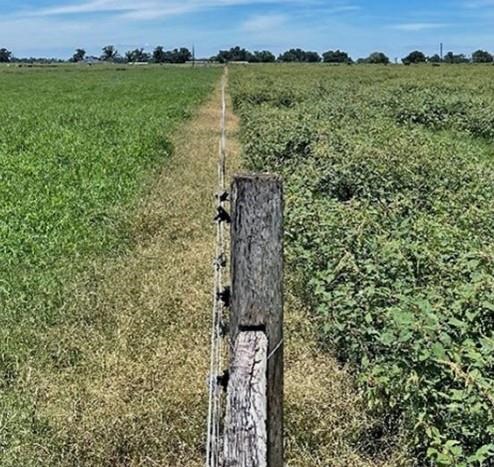
Figure 1. Bermudagrass pastures with control of spiny pigweed infestation (left) or without controlling spiny pigweed infestation (right) at UF IFAS NFREC Marianna. Photo credit: Jose Dubeux, UF/IFAS
Primary productivity and stocking rate
Weeds compete for water, so in conditions of limited water supply there will be a significant reduction in the forage productivity. Plants with different physiology (C3 or C4) have different efficiencies using water. For example, C4 (tropical) plants such as warm-season perennial grasses (e.g. bahiagrass, bermudagrass) are more efficient using water than C3 (temperate) plants (e.g. dogfennel, thistle), and C3 weeds will use 2-3 times more water to produce similar amount of biomass. The net result is that for every 1 lb of dry matter of C3 weed we are losing 2-3 lb of C4 grass biomass. If water is a limiting factor, this will severely limit pasture productivity. The reason weeds thrive under grazing conditions is that livestock avoid them, therefore, they have a great competitive advantage. Besides, many weeds are locally adapted and produce large amounts of seeds, reseeding naturally every year.
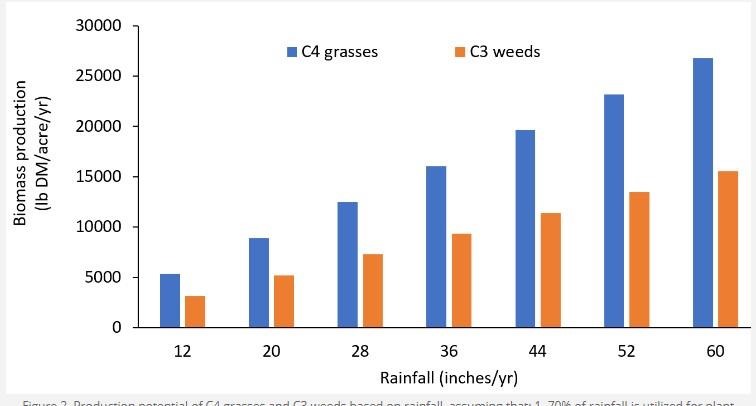
Figure 2. Production potential of C4 grasses and C3 weeds based on rainfall, assuming that: 1. 70% of rainfall is utilized for plant growth; 2. Water use efficiency for C4 grass is 350 lb water/lb DM and for C3 weeds is 600 lb water/lb DM.
Weed encroachment will also reduce stocking rate, because less forage will be available for grazing. Using the data from Figure 2 above, and simulating increasing levels of weed encroachment, we developed Figure 3 below. It is clear that as weed encroachment increases there is a simultaneous decrease in the stocking rate because of lesser forage mass available for grazing.
Figure 3. Stocking rate as affected by proportion of weed infestation. Assuming: (1) 36 inches of rainfall during the growing season, and that 70% of the rainfall is utilized for plant growth; (2) Water use efficiency (WUE) for C4 grass 350 lb water/lb DM, and 600 lb water/lb DMfor C3 weeds; (3) Stocking rate is based on 600-lb steer consuming 2.5% BW per day (15 lbs. DM/d).
How does weed encroachment affect animal production per area?
There are numerous components that affect animal production (Figure 4 below) and weed encroachment can affect many of these components. For example, if forage production is reduced because of weed competition, the consumption per unit area will reduce and negatively affect the stocking rate. Likewise, if weed infestation negatively affects voluntary intake and reduces nutritive value, there will be a decrease in the output per animal, which combined with reduced stocking rate will decrease overall pasture productivity.
Figure 4. Components of animal production per unit area. Red arrows indicate areas where weed encroachment will have a negative effect on animal production per area. Adapted from Moot and Moore (1985).
Voluntary intake of livestock on grasslands can be broken down in different components as well (Figure 5 below). Canopy structure affects several of those components, such as bite depth, bite area and canopy bulk density, ultimately affecting the bite weight. Grazing animals try to compensate the reduced bite weight by increasing their grazing time up to a limit, but at some point, the net result will be reduced intake and decreased animal performance.
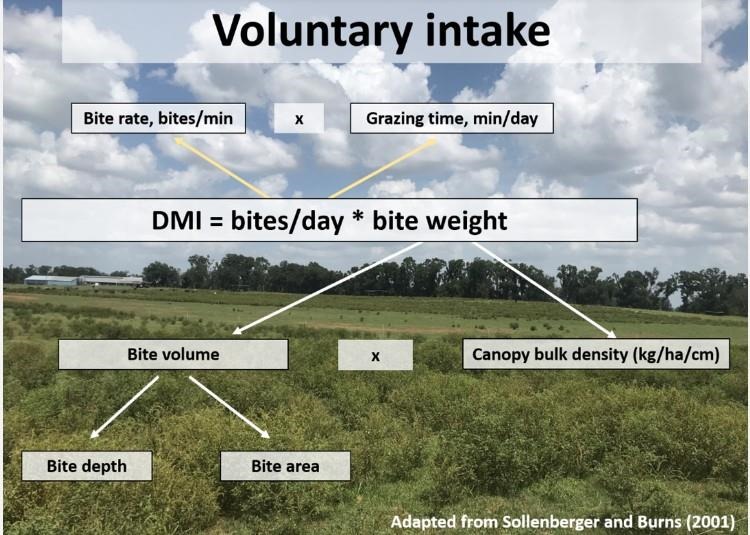
Figure 5. Components of voluntary intake in grazed grasslands. Credit: Jose Dubeux, UF/IFAS
Grazing management and weed encroachment
Grazing management can help prevent weed infestations before the weeds take off. Providing greater soil cover and having a solid canopy of the preferred forage is key to minimizing weed infestations. A closed canopy will reduce light reaching the ground and reduce weed germination. Once the weed seeds germinate and grow above the forage canopy, they must be controlled, since they are not grazed and are locally adapted. Typically, the earlier the weeds are controlled, the lower the cost of control.
Take Home Message
- Weed encroachment reduces livestock performance, animal health, and decreases land productivity.
- Grazing management might reduce weed encroachment as a preventive tactic, but once weeds are established, they must be managed.
- Weeds reduce livestock output per area by affecting forage productivity, forage utilization, forage nutritive value, and voluntary intake.
Source : ufl.edu