By Glen Arnold
Farmers in northwest Ohio are getting favorable weather for planting this week. Although we had a very good spring for manure application there will be livestock producers using manure with newly planted and emerged corn.
With the H2Ohio manure practices in mind, a liquid swine manure corn side-dress research plot was conducted at the Ohio Agricultural Research and Development Center Northwest Station in 2020. The treatments were 200 pounds per acre of nitrogen incorporated as 28% Urea Ammonium Nitrate (UAN); 5,000 gallons per acre of swine finishing manure subsurface applied with a manure tanker and Dietrich sweeps; and 5,000 gallons per acre of swine finishing manure surface applied and incorporated the following day with a row cultivator in accordance with H2Ohio requirements. The swine finishing manure had 40 pounds of available first-year nitrogen per 1,000 gallons so the swine manure treatments each received 200 pounds of nitrogen per acre.
Corn was planted the 1st week of May and was followed by a heavy rain and unusually cool weather. Crop emergence was slow and the population was approximately 25,000 plants per acre. All manure and commercial fertilizer treatments were made in early June when the corn was in the V3 stage and replicated four times.
Rainfall for the months of May 1st through September 15th totaled 12.11 inches which was well below normal. Stand counts were taken in late September with no differences found between the treatments. The plot was harvested the 2nd week of October.
Table 1. Yield Results
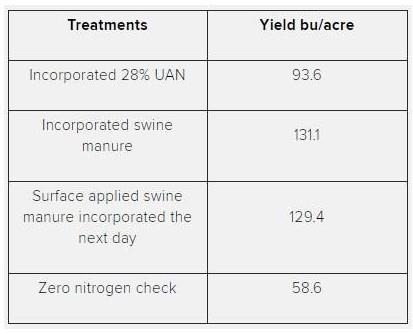
Corn yields were hampered by the dry crop season. Both swine manure treatments produced higher yields than the 28% UAN. The yields of the subsurface applied manure, and the manure that was surface applied and incorporated the following day with a row cultivator, were statistically similar. The subsurface applied manure yielded 131.1 bushels per acre and the surface applied manure, incorporated the following day, yielded 129.4 bushels per acre.
The H2Ohio practice of surface applying manure and incorporating the manure within 24 hours worked well in this study. For producers not in the H2Ohio program, if manure can be incorporated within 24 hours you can still save most of the ammonium nitrogen from escaping.
Source : osu.edu