By John Jennings
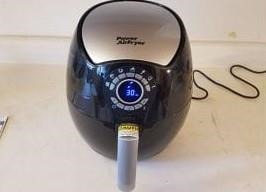
Measuring moisture content of forage cut for hay or silage is an essential step to ensure storage stability and product quality. Hay baled with too much moisture can mold or be subject to spontaneous heating. Silage baled or chopped at moisture contents outside a recommended range may not ferment properly, reducing storage life and animal acceptance. A relatively new method of measuring forage moisture content is through use of an air fryer. this household appliance is basically a small convection oven. it can be used at the farm shop or can be operated in the field from a generator to provide accurate forage moisture readings.
Steps for using an air fryer to measure hay moisture
Materials needed:
- air fryer
- gram scale
- wire screen to hold sample in place during drying (needed on some models)
- plate or bowl to contain sample for weighing
- calculator
Steps:
- Take a core sample from test bales or cut up a representative hay sample into small pieces (less than 1 inch) and weigh 100 grams onto a paper plate.
- Pour the sample into the air fryer.
- Place a screen over the sample to hold it in place during drying.
- Set the air fryer to 250°F for 30 minutes.
- Weigh the dried sample and calculate the dry matter content.
Calculating hay moisture
Remember that for 100-gram samples, the number of grams of moisture lost equals the percent moisture.
Example
A 100-gram sample was dried and the final weight was 80 grams
100 – 80 = 20 grams moisture lost = 20% moisture
If other than a 100-gram sample is used, use this equation to calculate hay moisture content:
starting weight (grams) – final weight (grams) / staring weight (grams) x 100 = % moisture
Example
The starting weight was 90 grams and the final weight of the sample is 70 grams. Subtract 70 grams (final weight) from 90 grams (starting weight) to get the amount of moisture lost during drying. Divide the amount of moisture lost by the starting weight and multiply by 100 to get the final moisture percent.
90 – 70 = 20 grams of moisture lost
20/90 x 100 = 22% moisture
Source : osu.edu