By Ricardo Costa
USDA grant provides opportunity to improve agricultural water quality by accelerating the adoption of a conservation drainage practice.
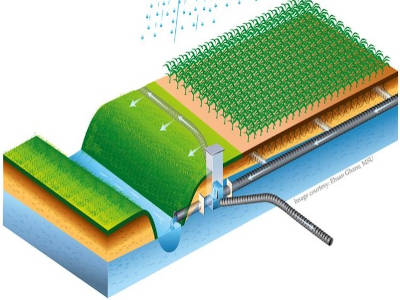
Saturated buffer.
Ehsan Ghane, assistant professor and Extension specialist at the Michigan State University Department of Biosystems and Agricultural Engineering, will lead a three-year, $614,00 grant from the USDA Natural Resources Conservation Service (NRCS).
The goal of the project is to improve agricultural water quality by accelerating the adoption of saturated buffers. A saturated buffer is a type of a conservation drainage practice that reduces nitrate loss from subsurface-drained fields. Too much nitrate in surface water causes low levels of oxygen (hypoxia). Low oxygen levels in water kill fish, which negatively affect the economy and environment.
In this project, a qualified team of experts with diverse backgrounds will develop a user-friendly online tool to improve the design of saturated buffers on specific farms. The value of the online tool is to show the best design that removes more nitrate at a lower cost of the saturated buffer.
Farmers want to protect water quality while producing crops. This tool will give them the means to see the benefit of a saturated buffer on their farm. Once the tool is developed, Michigan State University Extension will offer workshops to educate people on using the tool.
Source : msu.edu