By Seth Truscott
A team led by scientists at Washington State University’s Center for Sustaining Agriculture & Natural Resources (CSANR) is establishing the Specialty Crop Climate Change Extension Academy to improve Extension and USDA professionals’ capacity to support climate preparedness.
The new training academy is being funded by a $1.5 million Climate Hub grant from the USDA Agriculture and Food Research Initiative’s Foundational and Applied Science Program. Its goal is to facilitate forward-thinking conversations about climate change resiliency among professionals in the fruits, vegetables, seeds, and other specialty crops industries.
“This new academy is about finding peers in specialty crop agriculture and making connections across regions,” said Chad Kruger, CSANR director and lead investigator of the training project, titled “Analogs for Dialogs.”
This fall, team members will recruit a cohort of 20 Extension and USDA Climate Hub professionals in major centers of U.S. fruit and vegetable production to the academy. Recruits will learn about climate change factors and communication strategies, developing their ability to support grower preparedness.
A major focus of the project is fostering cross-regional connections through climate analogs: for each target region, an “analog” site will be chosen with a current climate that matches the target’s expected future. Participants from paired sites will engage virtually and through site visits.
“Conversations that help growers get to know their counterparts, and what they’re dealing with, will empower them more than us simply giving them information,” said project manager Teal Potter, a postdoctoral researcher with CSANR. “We’re looking for people who know there’s a need to prepare for a changing climate, but don’t really know what to do about it.”
Collaborating with the grant team, Siddharth Chaudhary and Kirti Rajagopalan, scientists with WSU’s Department of Biological Systems Engineering, study the value of analogs for cross-regional conversations on climate change adaption. Their recently published research in Scientific Reports characterized analogs for all specialty crop counties in the U.S., bringing together Extension professionals from paired locations to discuss regional practices.
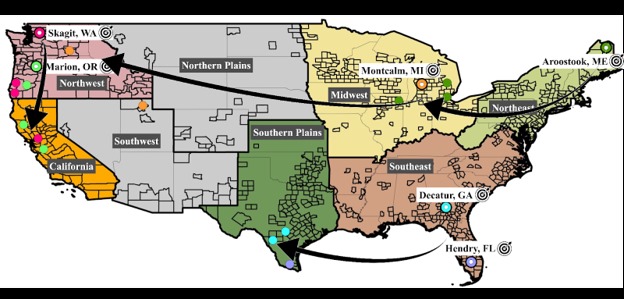
A map of the lower 48 U.S. states, showing eight USDA Climate Hub regions and potential cross-regional connections for climate change and specialty crops. The arrows show target-analog pairings between specialty crop-growing counties; from recent research by WSU scientists.
In a complex system like agriculture, climate change creates opportunities and risks, with multiple dimensions and tradeoffs,” Rajagopalan said. “You need multiple iterations of interactive dialog to capture the nuanced insights that lead to climate preparedness for society. Who better than Extension professionals to create the bridge between research, Extension, and society?”
Team members represent WSU, the University of Florida, the University of Minnesota, and the Ag and Food Systems Institute, and work in partnership with six regional USDA Climate Hubs.
Academy participants will be admitted this fall, with training beginning early in 2024.
Source : wsu.edu