By Doug Mayo
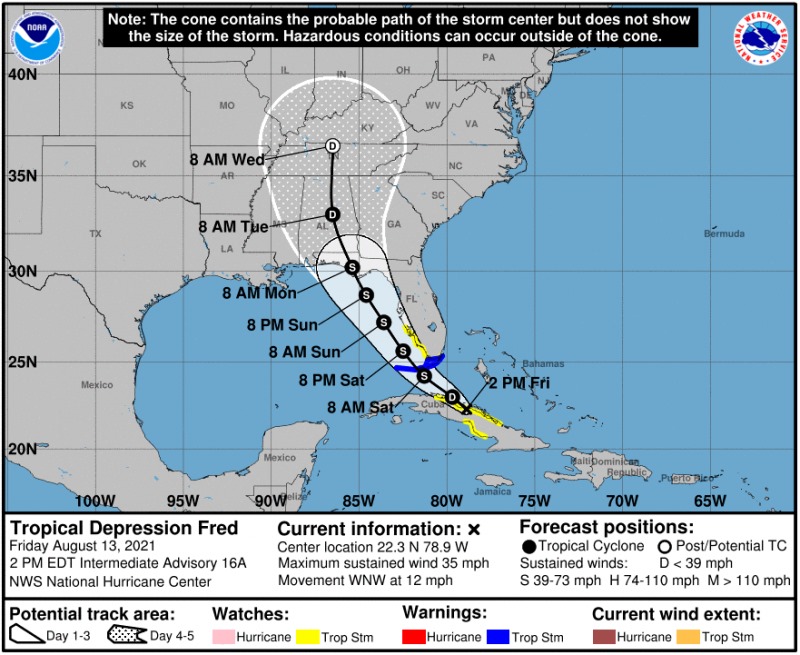
The map above is most recent forecast track for Tropical Storm Fred from the National Hurricane Center (NHC). Farmers and ranchers have limited time to prepare for what is coming on Sunday and Monday. At this point the forecast track (2 PM 8/13/21) is not very accurate, as this storm is still reorganizing after passing over the islands of Hispaniola (Dominican Republic/Haiti) and Cuba. The National Hurricane Center’s (NHC) cone of the probable path is still very large showing the track could go anywhere in the Panhandle at this point. As the storm moves along the Gulf Coast of Florida the forecasters will have a better feel for general speed and direction of this storm, so I would expect a much more accurate forecast to be shared on Saturday evening or Sunday morning. However, by the time we know more precisely where TS Fred is headed, there won’t be much time for preparation on the farm. You can see a continually updated version of this map by using the following link to the National Hurricane Center’s website for this storm:
Source: National Hurricane Center (NHC)
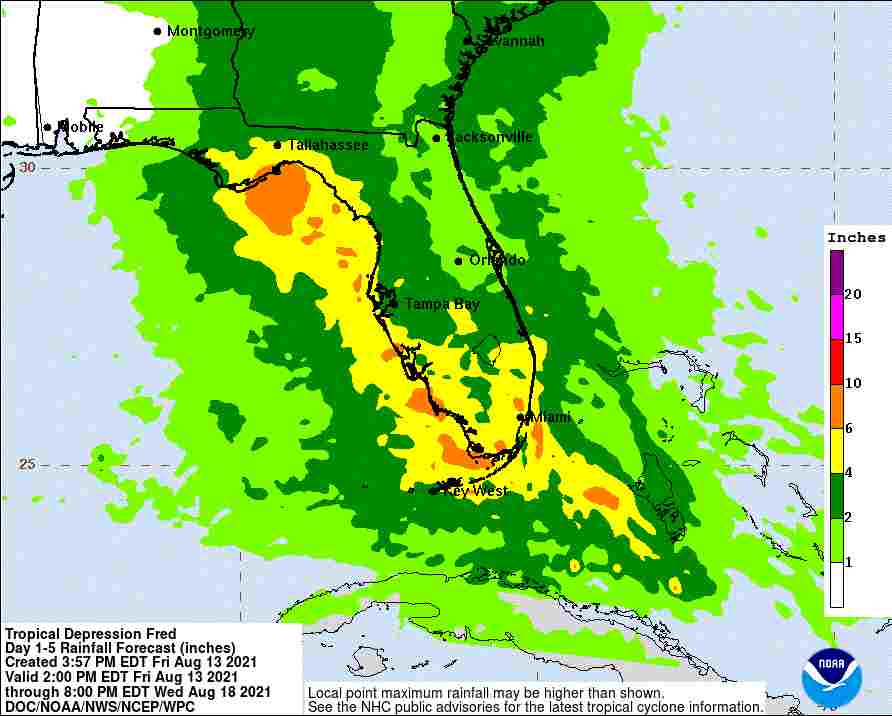
Since this storm is expected to remain a Tropical Storm when it makes landfall in the Panhandle, one the key concerns is flooding from heavy rainfall in a short period of time. The map shown above shares estimated rainfall totals (2 PM Friday), but just like the probable path cone map, the estimated rainfall map will be updated as the storm track become more certain. On Friday afternoon, the NHC was expecting most of Florida to receive some rainfall from this storm as it passes through. This will likely change when they have a more precise forecast of exact location of landfall for the center of circulation. However, tropical storms are not tightly organized like hurricanes, so the rainfall from this storm can be far reaching from the center of circulation. At this point the NHC is expecting 2″- 4″ for the majority of the state of Florida, with higher totals in South Florida and in the Big Bend area from Panama City to Perry. This is likely to change with a more accurate forecast, so use the link provided above to see these rainfall forecast maps as they are updated throughout the weekend.
Preparing Your Farm for a Tropical Storm
Develop a plan and prepare ahead of the storm, rather than just waiting until after the storm to deal with the mess. Tropical Storm Fred is not expected to gain hurricane strength, but be prepared for isolated tornadoes, flash flooding, loss of power, and downed trees and large limbs. Likely the biggest impact from this particular storm will be heavy rainfall, but there could be other issues to deal with as well.
Flooding
Tropical storms can generate 3-15 inches of rainfall for inland areas in just a few hours.
- Move tractors, equipment, hay, or other stored items to high ground.
- Move animals out of low lying pastures, or at least tie gates open so they can move to higher ground if needed.
- Make sure drainage ditches are clean without blockage.
Loss of Power
Heavy rainfall, flooded roots and periods of higher winds can make trees and limbs fall on power lines. Be prepared for power outages. In rural areas, power outages may not be addressed as quickly as in urban communities. Stock up ahead of the storm and make sure generators are ready to operate if needed.
- Order fuel to top off farm fuel tanks for tractors and equipment. Fuel deliveries may be disrupted following the storm.
- Fill farm and family vehicles with gas. Local gas stations may not be open after the storm passes.
- Purchase batteries for flashlights and lanterns. Have enough working flashlights ready for each employee.
- Move animals to pastures with ponds, so water troughs are not the only source of water. Have a generator ready for well operation, if ponds are not adequate.
- Dairy farms should have enough generator power so that cows can be milked each day. Make sure it runs before you need it for an extended period.
- For operations that rely on electric fencing, have a generator ready to keep the fence hot, or at least move animals to interior pastures, so they have multiple fences to help keep them in.
Tree Damage from Flooding and Wind
Coastal areas will receive the highest winds, but even 40-50 mile per hour winds for an extended period combined with heavy rainfall will cause damage from trees. Barns and fences are very susceptible to fallen trees and limbs from even tropical storm force winds. Tornadoes are also a concern within outer bands as storms move through.
- Make sure chainsaws are in good working order and stock up on mixed fuel.
- Locate chains and come-a-long for limb and tree movement off of fences and buildings.
- Stock up on fence repair materials: wire, posts, and staples for repairing fences damaged by limbs and trees. Have some T-Posts on-hand for quick emergency repairs along highways.
- Move animals and valuable equipment away from large trees and into open areas away from potential tree damage.
- Pick up materials and debris that might become high-wind hazards.
- Be prepared to remove and clean up broken limbs and uprooted trees on cowpens, fences and buildings following the storm.
Clean Up and Damage Assessment after the Storm Passes
Notification and documentation are the keys to getting financial aid following a tropical storm.
- Beware of downed power lines. Treat them as if they are charged even if they are damaged or knocked down by tree limbs. If you drive up near a downed power line, stay in your vehicle, and contact emergency personnel or the utility company.
- Contact insurance agencies as soon as possible after the storm passes for buildings, vehicles, and equipment that are insured.
- Report major damage to the local Farm Service Agency within 15 days of the storm to be eligible for federal disaster aid. Take some photos that show major flooding and damage to crops and livestock or facilities.
- Document damage and repair expenses. Photographs of damages and receipts for services and materials will be very important when applying for insurance claims and federal disaster aid. Any purchased feed, supplies, equipment, veterinary expenses, or extensive labor requirements related to storm damage should be recorded as well. Kalyn Waters, Holmes County Extension, developed some example spreadsheets for documenting storm damage and restoration expenses: Documentation for USDA-FSA Disaster Relief Programs.
- Your county agent may also be contacting you after the storm for estimates of crop, livestock, and facility damages to report to report losses to the Florida Department of Agriculture and USDA. Have a general idea of the damages to each major enterprise so that accurate damage assessments can be shared with USDA.
Source : ufl.edu