The provincial government will invest more than $343 million over five years in the Ontario Agri-Food Innovation Alliance, a unique collaboration among the University of Guelph, the Ontario Ministry of Agriculture, Food and Rural Affairs (OMAFRA) and the Agricultural Research Institute of Ontario (ARIO).
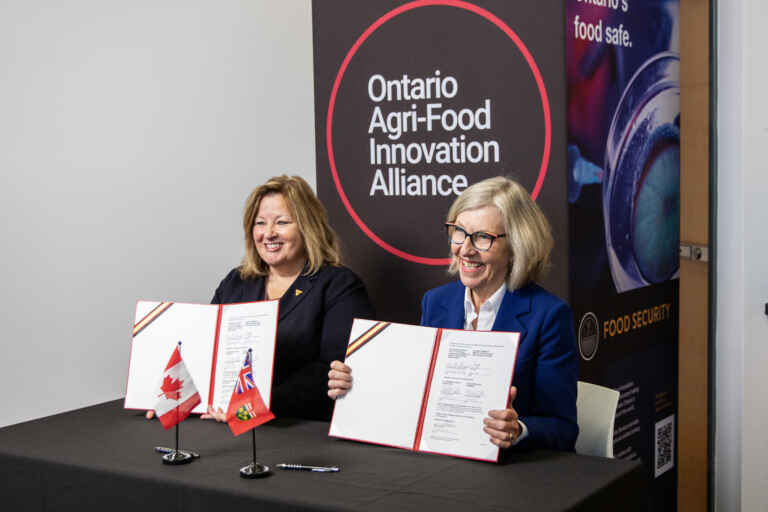
Ontario Minister of Agriculture, Food and Rural Affairs Lisa Thompson, left, and U of G president Dr. Charlotte Yates
The Alliance leverages U of G expertise and brings together academia, government and industry to support Ontario’s $47-billion agri-food sector with cutting-edge research and innovation, training and laboratory services.
“The University of Guelph applauds the Government of Ontario for its continued support and strengthening of Ontario’s agri-food sector, bringing industry, government and university together to form a unique, world-class partnership,” said University president Dr. Charlotte Yates. “Using our expertise, the University leverages this government investment to protect plant and animal health, guard against new disease and environmental challenges, safeguard Ontario’s food supply and support leading agri-food innovation.”
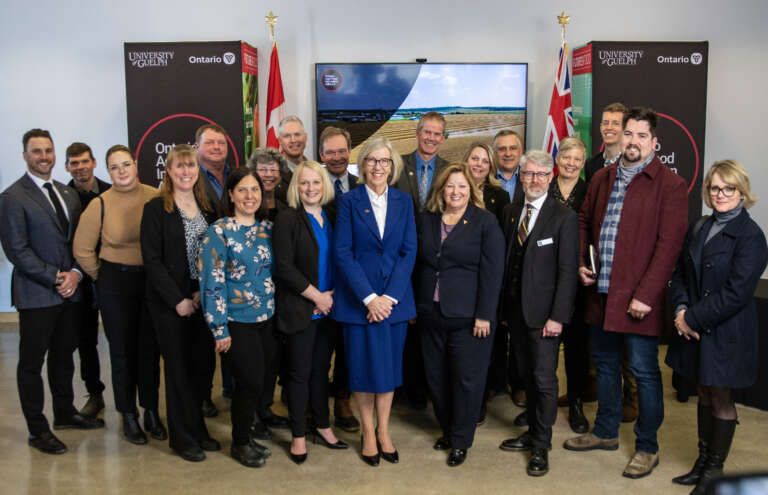
Representatives from U of G, OMAFRA and ARIO and industry partners
The Alliance increases Ontario’s GDP by $1.4 billion and has an annual economic impact of approximately $120 million.
“The future of the province’s agri-food sector is bright and through this investment we continue to enable Ontario to be a world leader in agri-food research and innovation.” said Lisa Thompson, Minister of Agriculture, Food and Rural Affairs. “By continuing our long-standing partnership with the University of Guelph, our government is demonstrating its commitment to Ontario’s agri-food research infrastructure, providing knowledge transfer and research-driven results to farmers to boost their competitiveness now and in the future.”
U of G and OMAFRA share a strong dedication to agri-food innovation, working together to generate new knowledge and supporting the agri-food sector for over a century through U of G’s founding colleges and institutions.
A group of people pose for a photo
Representatives from U of G, OMAFRA and ARIO and industry partners
The Alliance’s unique platform includes opportunities for developing skilled talent, optimizing the province’s network of research centres to develop on-farm solutions for Ontario’s livestock and crop producers, and managing threats to food production and food security, such as African swine fever.
“The renewal of this landmark agreement enables U of G researchers to continue to successfully create and apply groundbreaking, globally relevant innovation to address the challenges and opportunities in the agri-food sector and rural communities,” said Dr. Malcolm Campbell, vice-president (research). “By working together, our university and government generate impactful discoveries and innovations, train the talent for tomorrow, and continue to create an equitable, prosperous and sustainable agri-food sector for Ontario, Canada and the world.”
The renewed agreement also reflects the principles of Indigenization, equity, diversity and inclusion, value for money, leadership, innovation and excellence. It comes into effect on April 1, 2023.
Among many examples of the groundbreaking research and innovation stemming from the Alliance are the following:
Research that helps dairy producers lower their carbon footprint while supporting their bottom line: OMAFRA’s investment in research centres and environmental stewardship research through the Alliance has helped producers implement science-based best management practices to reduce their carbon footprint, improve sustainability and support farm profitability. (U of G researcher: Dr. Claudia Wagner-Riddle)
U of G-bred soybean varieties accounting for nearly 50 per cent of the food-grade soybeans grown in Ontario and shipped around the world: The publicly funded soybean breeding program at U of G released more than 280 new varieties since 1970. (Dr. Istvan Rajcan and Dr. Milad Eskandari)
The Animal Health Laboratory (AHL) providing avian influenza testing services for poultry producers: As part of Ontario’s enhanced surveillance strategy, AHL has worked with the Canadian Food Inspection Agency on the detection and surveillance of avian influenza and works with OMAFRA to increase surveillance capacity and capabilities in Ontario to limit further spread in the province. In 2015, the AHL was instrumental in helping contain an outbreak of H5N2 avian influenza in Ontario, with minimal disruption to the province’s poultry industry.
Source : University of Guelph