By Christine Gelley
The time has come for Canada thistle flowers to line the roadways and begin to bud in pastures and hayfields. The lavender-colored aggregate flowers that develop into fluffy seed are one of the most distinguishing characteristics of the plant. They are easy to find blooming from June through August. If it wasn’t such an unpleasant plant to encounter, I might call it pretty. It isn’t poisonous, thank goodness, but it certainly is troublesome. Some animals will tolerate it while grazing, but most will avoid it while it is growing or sort it out of a hay bale.
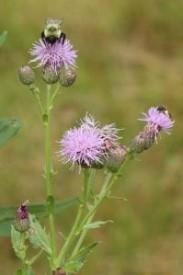
If Canada thistle was easy to control, it wouldn’t be on the noxious weed list.
Its common name may give the impression that the plant is native to North America, but alas, it is not. It is actually native to Eurasia and was probably introduced here during colonial times in ship ballast. In its home range it is commonly known as “creeping thistle”. It was labeled with the name “Canada thistle” by New Englanders who blamed its introduction on French tradesmen from Canada. Whatever you choose to call the plant, it is a noxious weed in many countries worldwide, along with the State of Ohio. Because of this status in Ohio, it is every landowners’ legal responsibility to work to control Canada thistle.
There are multiple reasons why controlling Canada thistle is a difficult task. It is well adapted to many environments and will even grow unassisted in sand, although clay loam soils are preferred. It spreads easily by creeping underground roots. One plant has the ability to produce thousands of seeds that can be dispersed by wind, water, and wildlife and have the ability to remain viable in the soil for 20 years. It is especially common to find in drained marshy or frequently flooded ground.
If it were easy to control, it wouldn’t be on the noxious weeds list. Due to factors listed above, it will take multiple approaches and seasons to control Canada thistle. Aggressive mowing may be helpful to suppress seedhead development, but it will readily grow back from the creeping root system. Hand pulling or tillage can be helpful, but the roots may lie 3 feet below the surface and spread laterally in extensive networks. It is responsive to some systemic herbicides, but it is also developing resistance to many “go-to” options. Grazing may be a possibility if you train animals to consume it or find one that seems to enjoy the plant (yes, I have heard they exist).
I suggest trying some of everything if you have a Canada thistle problem. Strategic defoliation in combination with well-timed herbicide application may work best for perennial grassland ecosystems. Herbicides that provide good to excellent control on Canada thistle include: glyphosate, dicamba, 2,4-D, clopyralid, and aminopyralid and combination mixes of these ingredients. Appropriate timing and rates for application depend on the conditions of the site, the time of year, and the surrounding desirable vegetation. Always follow the instructions on the herbicide label. For assistance finding the best selection for your situation, contact your local ANR Educator to discuss the options that will address both Canada thistle and other problematic weeds that are prevalent on your property.
Source : osu.edu