By Dean Malvick
Tar spot of corn has continued to develop in many fields across southeastern and into central Minnesota. Fortunately, with the exception of some areas in southeastern MN, tar spot has been detected at low levels that are not affecting yields. In the next week or two is a great time to scout for tar spot to determine where this disease has spread.
Based on observations in many states and fields, the fields at greatest risk of yield loss due to tar spot are those fields where rains have been frequent and tar spot has developed in previous years.
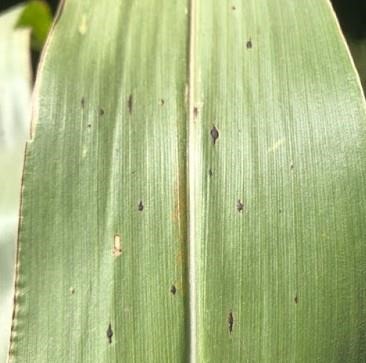
Tar spot at low level of infection.
Yes, tar spot can spread between fields. However, yield loss often occurs in fields where the disease starts to develop in July, which are also often those fields where tar spot has developed previously. Thus, it is important to determine when and where tar spot is spreading. The map of known distribution of tar spot in MN can be found at this web site: https://corn.ipmpipe.org/tarspot/. However, tar spot is undoubtedly developing in other counties west and north beyond those noted on this map.
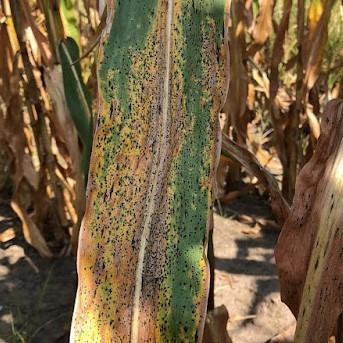
Tar spot at higher level of infection
Corn tar spot has become easy to find in many areas outside of SE MN in just the last 2 weeks, even in areas with little rain over the past 3-4 weeks. The small tar spots are black and typically elongated, extend through the leaf from top to bottom, and cannot be wiped or easily scraped from the leaf. Leaves in new areas may only have a few tar spots. Tar spot can also produce fisheye symptoms that appear as tan lesions surrounding the black spots.
If you see leaves that you suspect to be infected with tar spot, please contact me (dmalvick@umn.edu) and send information and close-up photos. Or submit your information to the Digital Crop Doc system (https://extension.umn.edu/crop-production/digital-crop-doc). I would like to receive reports and photos from anywhere tar spot is found, especially from counties where the disease has not yet been confirmed in Minnesota. Your samples and observations will help us track spread and development of tar spot in Minnesota.
Source : umn.edu