By Justin McMechan and Thomas Hunt et.al
On June 8 and 9, several sites in east-central and northeast Nebraska recorded emergence of soybean gall midge adults (Figure 1). At this point, growers with a history of issues with soybean gall midge in Nebraska should consider making field edge applications on soybean adjacent to fields that had issues the previous year. Soybean fields should be at the V2 stage or greater when considering an application. Clientele should continue to follow adult emergence at all locations through the Soybean Gall Midge website.

Figure 1. Soybean gall midge alert network trap sites with a yellow dot indicating activity and the number of adults collected at that site. (Click to expand)
Soybean Gall Midge: Should I Spray Checklist
? Soybean gall midge adults have emerged in my area
? My soybean field is at the V2 stage or greater
? I observed soybean gall midge injury in the adjacent field last year
For soybean growers near the site with activity (Figure 1) and that have had issues with soybean gall midge, they can consider making an application if their soybean fields have reached the V2 stage. Based on two years of data, soybean plants prior to the V2 (Figure 2a) stage generally lack the presence of cracks or fissures (Figure 2b) at the base of the stem. Plants without fissures are not considered to be susceptible to soybean gall midge infestation.
If growers have fields at VC or V1, we recommend waiting until V2 to make an application if they are in a high-risk area and have adult activity occurring. With only a few years of observations of adult emergence, you should check the Soybean Gall Midge website to determine if emergence is still occurring when your soybean reach the V2 stage.
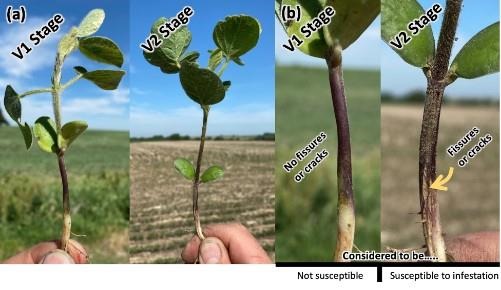
Figure 2. Soybean plants (a) at V1 and V2 stage with close up of the stem (b) showing differences in the formation of fissures or cracks at the V2 stage. (Click to expand)
Source : unl.edu