By Erin Hill
As we begin to prepare for fall harvests and make plans for 2022, consider any weeds that have escaped control with herbicides. If you are seeing survival in weeds that used to be controlled by your herbicide program, herbicide resistance could be an issue. Michigan State University Plant & Pest Diagnostics offers bioassay screening of weed species for herbicide resistance starting in the fall and winter months of each year. This screen can confirm resistance and rule out the many other factors that could contribute to weed escapes.
To screen for resistance, seeds are cleaned from dried plant material, treated for dormancy, grown in the greenhouse and treated with up to seven different herbicides (herbicides screened are based on the species, cropping system, suspected resistance, and quantity of seedlings). A known susceptible population is tested alongside all samples to verify results. The duration of the process depends on the species, but results are usually available no later than March. New incidence of resistance (i.e., not previously confirmed in Michigan) require additional testing.
If you are a soybean or vegetable grower, you likely qualify for free screening. The Michigan Soybean Promotion Committee will again be sponsoring the testing of select species (i.e., pigweeds/amaranths, ragweeds, horseweed and common lambsquarters) for Michigan soybean growers. Sushila Chaudhari, MSU Extension edible specialty crop weed scientist, has also received a grant from the Michigan Vegetable Council to sponsor herbicide resistance screening of any weed species in vegetable crops.
The cost of screening for non-soybean, non-vegetable growers, or for species not listed above for soybean growers, is $90 per sample. If you intend to submit a species not listed above, including vegetable growers, please consult with us ahead of time to ensure we have or can collect a known susceptible population of the same weed species (contact Erin Hill at hiller12@msu.edu).
Most weed seeds from summer annual species are maturing by September to October, depending on the species and time of emergence. If you plan to submit a sample, refer to the factsheet “Tips for Collecting Weed Seeds” to ensure you collect mature seeds (Figure 1), gather a sufficient quantity and package them properly. If the species you are submitting is not on the sheet, we can discuss tips for successful collection of mature seeds on a case-by-case basis. A submission form is needed with the sample, which can be found at the link or on the general Plant & Pest Diagnostics website.
We ask that all samples be submitted no later than Nov. 19, 2021, to ensure testing over the winter months.
Further information on herbicide-resistant weed species confirmed in Michigan can be found on the “History & Map of Herbicide-Resistant Weeds in Michigan” (Figure 2).
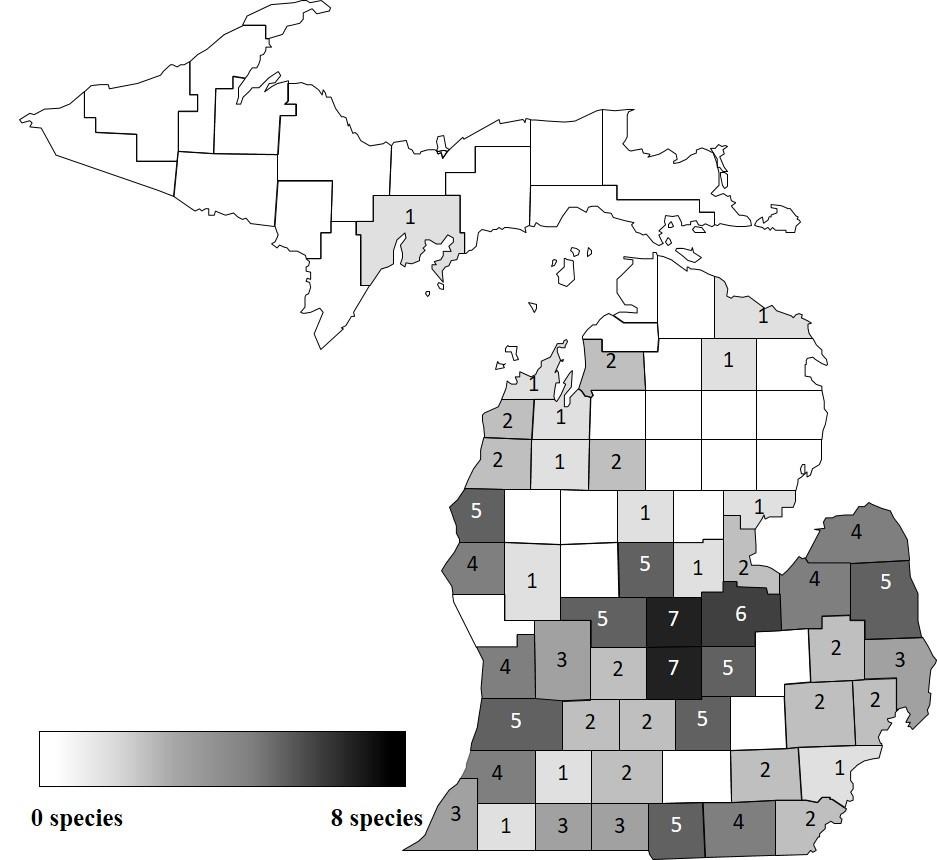 Figure 2. Distribution of confirmed herbicide resistant weed species in Michigan as of spring 2021.
MSU Plant & Pest Diagnostics is a fee-for-service laboratory that assists in determining the cause of a wide variety of plant health and insect pest problems.
Source : msu.edu