By Bradley Zwilling
Data from the Illinois Farm Business Farm Management (FBFM) Association provides insight into farmland tenure and leasing arrangements across Illinois. The data summarized in Tables 1 and 2 are drawn from Illinois grain farms enrolled in FBFM. These farms receive the majority of their income from grain production and operate at least 500 acres. While the dataset is representative of commercial grain farms in Illinois, it is important to note that it is not a statistical sample of all commercial grain farms in the state.
Statewide Tenure Patterns
Table 1 summarizes land control arrangements for FBFM grain farms from 2020 through 2024, including regional detail for northern, central (high SPR), and southern Illinois. In 2024, Illinois FBFM operators owned 24 percent of the land they farmed, crop shared 26 percent, and cash rented 50 percent of their operated acres. Under crop share arrangements, operators and landowners share both revenue and selected production expenses. In contrast, cash rent arrangements require the operator to pay a fixed or variable cash payment to the landowner while retaining all production risk and reward. Variable cash rent leases are classified as cash rent in this analysis.
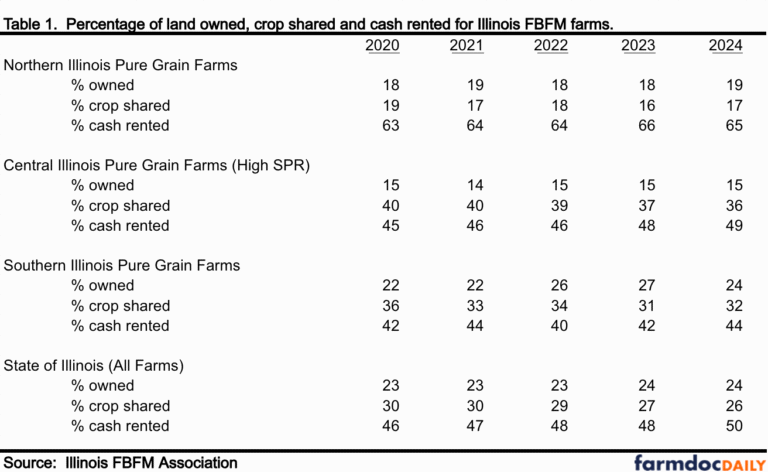
Over time, Illinois has experienced a gradual but consistent shift away from crop share leases toward cash rent arrangements. Statewide, crop-shared acres on the average farm declined from 30 percent in 2020 to 26 percent in 2024, while cash-rented acres increased from 46 percent to 50 percent over the same period as shown in Table 1. Although cash rent now accounts for a larger share of operated acres on the average farm, crop share leases remain an important component of farmland tenure. The most recent year in which crop-shared acres exceeded cash-rented acres was 2006; since then, cash rent has consistently represented the dominant lease type on the average farm.
Regional Differences in Leasing Arrangements
Leasing arrangements vary substantially by geographic region within Illinois, reflecting differences in soil productivity, farm size, crop rotations, and long-standing regional practices. As shown in Table 1, northern Illinois farms in 2024 cash rented 65 percent of their operated land, crop shared 17 percent and owned 19 percent. In contrast, central Illinois farms with high soil productivity ratings cash rented 49 percent of their acres, crop shared 36 percent – the highest share of crop share leasing in the state – and owned 15 percent. Southern Illinois farms averaged 44 percent cash-rented acres, 32 percent crop-shared acres, and 24 percent owned acres in 2024.
Source : illinois.edu