By Julie Murphree
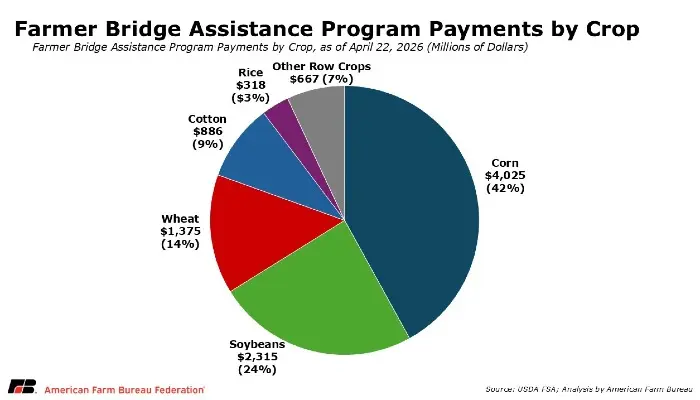
The U.S. Department of Agriculture has begun disbursing nearly $9.6 billion under the Farmer Bridge Assistance (FBA) program, a temporary lifeline for row-crop producers reeling from one of the worst economic downturns in recent memory. Designed as a stopgap ahead of broader safety-net improvements scheduled for later this year, the FBA payments aim to help bridge American farmers through historically low commodity prices and stubbornly high input costs for fertilizer and fuel. Corn and soybean acres have claimed the largest share of the aid so far, while specialty-crop growers await details on their portion of the remaining funds and sugar producers navigate a separate $150 million allocation.
Announced in December 2025 as part of a $12 billion package, the program set aside $11 billion for row-crop farmers who planted eligible commodities in 2025. Enrollment opened Feb. 23, with the application deadline April 17. After last week’s deadline closure, the Farm Service Agency has approved nearly 500,000 applications, issuing flat per-acre payments calibrated to the severity of 2025 losses. Payment rates are highest for crops such as cotton and rice, which suffered the steepest declines, though even producers of other major commodities face negative returns after accounting for the assistance.
The aid, while substantial, covers only a fraction of the sector’s mounting losses. Record-low prices combined with elevated production costs have pushed projected net returns into the red across all nine principal row crops, even after federal payments. With financial conditions continuing to deteriorate, the program underscores both the scale of the current distress and the limits of one-time relief.
Click here to see more...