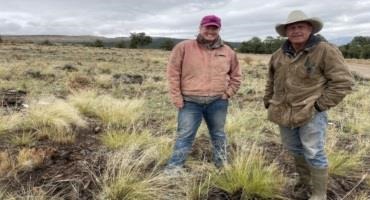
It’s a rainy day on Pat Luark’s ranch, north of Eagle. He drives through the mud to a stretch of public land his cattle graze. He and Kristy Wallner, a rangeland specialist with the U.S. Bureau of Land Management, pull over and examine the ground.
They spot bunches of native grass that dot the soil, a species that’s important to cattle and wild grazers like elk and deer. Luark and Wallner are delighted.
“If we would've got our normal rains, I see the potential of this grass being stirrup-high to the horse,” Luark said.
Luark and other ranchers’ cattle graze on millions of acres of public land in Colorado. How he and other ranchers manage their cows can affect the health of the land for livestock, wildlife and the climate.
Despite years of back-to-back drought worsened by a warming climate, the grass here seems to be improving. Luark and Wallner are crediting a new technology that allows them to move cattle without physical fences.
Under the system, cows are outfitted with shock collars — similar to ones for training dogs — that use GPS and reception towers to form a virtual fence controlled by a computer. The technology from Vence (for “virtual fence”) makes it easier for Luark to move his cattle and determine how long they should spend grazing in a particular spot.
He used the technology to keep his cows off 600 acres that needed to rest and regrow, a process that means healthier grass and soil when the cows eventually return. The Bureau of Land Management is funding the virtual fence experiment with a grant.
“Now we can move fences and use ground in a way we never have even thought about,” said Wallner, the bureau’s project manager.
Wallner sees a lot of benefits to using the Vence technology on BLM land. Without physical fences, wildlife can move freely across the landscape. Virtual fences also mean people recreating on public land won’t accidentally leave a cow gate open. And because the cattle’s location is updated on a digital map, ranchers will know if they’ve wandered into areas that are off-limits.
Moving livestock around improves ecosystem health, but rotational grazing isn’t a new idea. Ranchers use portable electric fences to do the same thing, but that comes with challenges. It’s labor-intensive, wildlife can knock fences down and some pastures — like on the side of a mountain — are hard to access.
Todd Parker, the director of product and program management for Vence, demonstrated how the software works in a training video. He pulls up a Google Map, which is marked up with different shapes representing pastures on a ranch. In one spot, there are dozens of little dots marking the locations of cows overlaid with orange lines showing the location of the virtual fence.
Parker said the Vence technology frees up ranchers to spend less time chasing cows and fixing fences and more time managing the health of their animals and the land. He said ranchers are worried they’ll be replaced by virtual fences, but he tells them the technology doesn’t eliminate the cowboy — it just changes the job.
Click here to see more...