By Steve Boyles
Some breeders choose to report performance data only on calves that they want to register. However, this is not in the best interest of either the producer or their customers as this practice leads to biased and inaccurate EPDs. Complete reporting of every animal in the herd is critical to obtain the best estimates of genetic merit. By only reporting the best calves, producers are inadvertently penalizing their highest-performing calves. In the following example, we will use weaning weight ratios to illustrate the effect of only reporting the best calves. Suppose we have 10 calves with an average adjusted weaning weight of 625:

Now suppose that the producer only reports the top 5 calves, which means the new average adjusted weaning weight is 675:
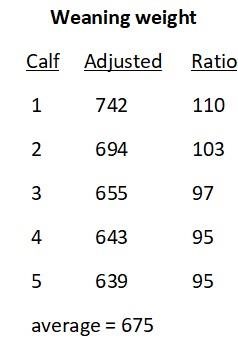
Incomplete reporting has the same effect on EPDs that it does on ratios. Therefore, the highest performing calves (calves 1 and 2) now receive much lower ratios, and subsequently EPDs, than if they had been compared to their entire contemporary group. Calves 3, 4, and 5 were once above average (ratios of 102-105) but are now below average and receive ratios below 100, which will result in lower EPDs than if they were compared to the entire group.
Next week we’ll take a look at Expected Progeny Differences and their Accuracy.
Source : osu.edu