By Sarah Lancaster
Stinkgrass (Eragrostis cilianensis) has recently started flowering at the K-State Agronomy Ashland Bottoms research farm in Manhattan and is this month’s World of Weeds feature.
Ecology of stinkgrass
Stinkgrass is a warm-season annual grass that is native to Europe. It can be found in fields, pastures, roadsides, and lawns throughout the United States.
Identification
Stinkgrass has hairless leaf blades that are 2 to 6 inches long and about 0.25 inch wide. The leaf sheaths are overlapping and hairless, except for a tuft of longer hairs at the collar. The ligule is a fringe of short, dense hairs (Figure 1, left). Stems reach up to 24 inches tall and are angled up at the nodes (Figure 1, right).
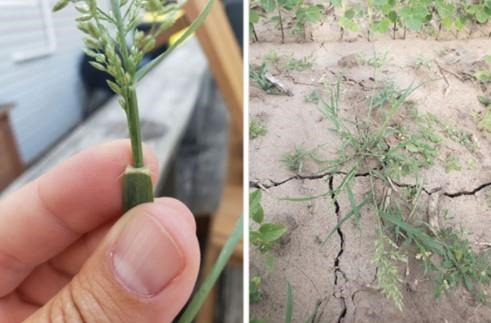
Figure 1. Left: Stinkgrass ligule and long hairs on collar. Right: Stinkgrass growth habit with stems bending upward at nodes.
Glands that produce the odor for which the plant is named can be found scattered along the veins of the leaves and leaf sheaths, as well as in a ring below the nodes.
The inflorescence is a dense, pyramid-shaped panicle, dark-green to tan in color and 2 to 8 inches long (Figure 2, left). Each spikelet contains 7 to 40 individual flowers (Figure 2, right).
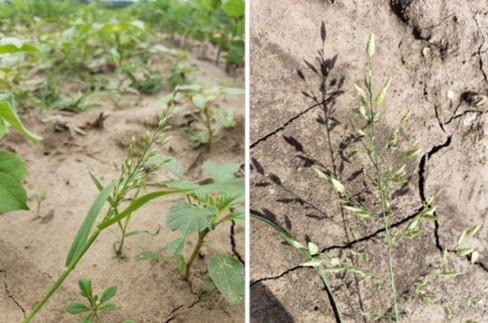
Figure 2. Left: Stinkgrass panicle emerging. Right: Stinkgrass florets with many flowers.
Management
There is limited research specifically evaluating stinkgrass control. Observations in herbicide evaluation trials at K-State suggest that Group 15 products such as Dual and Harness/Warrant provide suitable pre-emergence control. Greenhouse studies at North Dakota State University suggest that Liberty, Roundup, and Assure II provide excellent post-emergence control.
The use of trade names is for clarity to readers and does not imply endorsement of a particular product, nor does exclusion imply non-approval. Always consult the herbicide label for the most current use requirements.
Source : ksu.edu