Craig Sanok and Paul Chambers operate Dancing Goats Farm
By Diego Flammini
Assistant Editor, North American Content
Farms.com
A pair of dancers have traded in their ballet shoes for work boots to explore their new found passion for making goat cheese.
Craig Sanok and Paul Chambers, once both travelling ballet dancers, opened Dancing Goats Farm near Acme, Alberta, where they have 44 goats and 128 acres of land.
Eighteen goats are milked twice daily for a daily total of about 57 litres of milk.
Sanok said the idea for a farm came about after deciding his time as a dancer was coming to an end.
“When I retired from my performing career I was looking for the next passion I wanted to do,” Sanok told CBC’s The Homestretch. “I knew I wanted to work with animals and knew I loved working with food.”
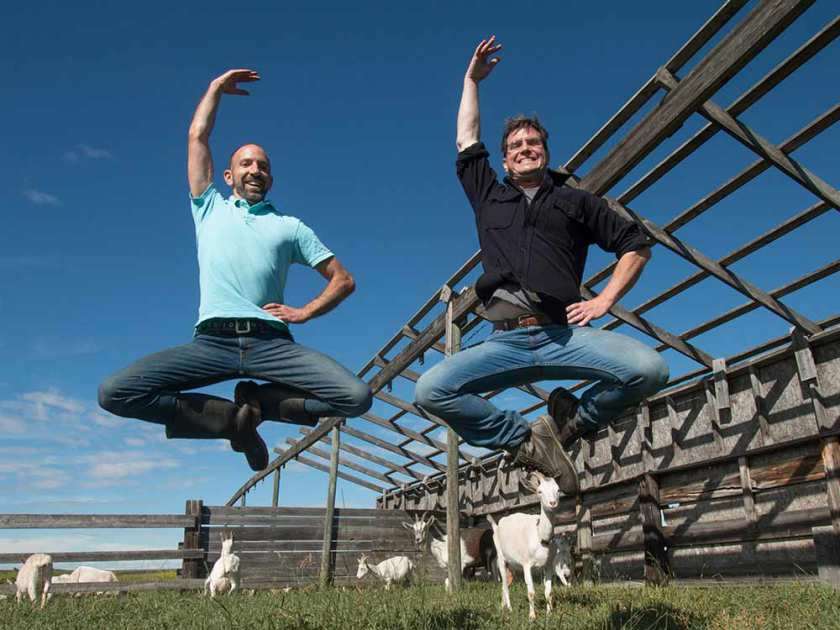
Craig Sanok, left, and Paul Chambers.
Photo: Calgary Herald
Sanok, who was born in the United States, said his passion for goats and goat cheese surfaced after helping his sister milk a neighbour’s goats.
"We came home and I figured out a really easy cheese recipe and made the cheese and served it her and my brother and his family and it was sort of one of those things that was incredible, being able to go from the animal to the table.”
Both men have dedicated themselves to the farm, the animals and the business, but Paul still teaches through Alberta Ballet.
“Our alarm goes off at around 5:30 a.m.” Chambers told CBC.
Watering, feeding and milking is repeated throughout the day. For three days each week, Craig makes cheese on site with names like Waltz and Two Step.