The family-run operation consists of about 20 acres of greenhouse
By Diego Flammini
Assistant Editor, North American Content
Farms.com
A group of about 50 Ontario Federation of Agriculture members (OFA) and Members of Provincial Parliament (MPP) toured Beverly Greenhouses in Dundas, Ont., as part of OFA’s annual Field Day.
The English cucumber operation consists of 30 total acres, about 20 of which are in greenhouse production.
And the VanderHout family, who own the farm, oversee every aspect of the cucumber’s development from seed to packaging.
Cucumbers are picked, packed and shipped on the same day. They could be in produce aisles anywhere between three and five days after harvest.
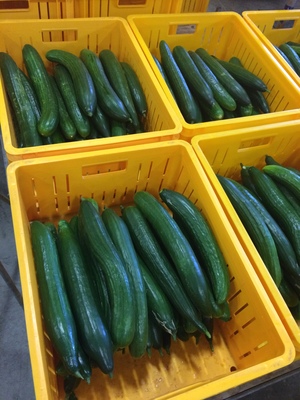
Baskets of cucumbers harvested Thursday at Beverly Greenhouses.
The production techniques on the farm include integrated pest management (raising aphids to control other pests), burning wood as a heat source in the winter and recycling any water unused by the cucumber plant.
The operation is a perfect example of what agriculture in Ontario is today, according to OFA president Keith Currie.
“From a state of the art facility to state of the art equipment, the farm is an exercise in agricultural production practices,” Currie told Farms.com. “It’s an assembly line with an agricultural focus.”
And showing those techniques to the public is a way to help dispel any misconceptions about agriculture.
“Today there are so many urban dwellers who have no exposure to a farm and that goes all the way up to the halls of government,” Jan VanderHout, who owns the farm with his brother Dale, said to Farms.com.
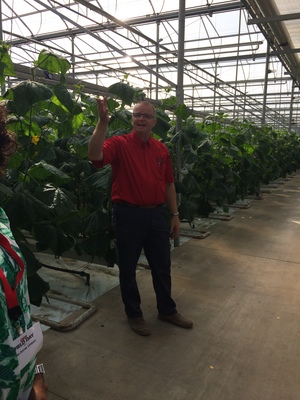
Jan VanderHout explains some greenhouse cucumber production practices.
“There’s lots of perceptions out there so it’s important for us to open our doors to let people see how a farm really works.”
MPPs attending the Field Day included former Ontario Minister of Agriculture Ted McMeekin (2011-2013) and current agriculture critics Toby Barrett (Conservative) and John Vanthof (NDP).
Political attendees also included Monique Taylor, NDP MPP for Hamilton Mountain, and Soo Wong, Liberal MPP for Scarborough-Agincourt. Both MPPs represent urban parts of the Greater Toronto and Hamilton Area.
The OFA hopes the urban representatives will consider rural Ontario’s needs and potential when the provincial government resumes activity in the fall.
“These are our lawmakers and regulators so they need to understand how what they’re doing impacts (agriculture),” Currie said. “When they see how farm operations are similar, yet different, it’s important for us that they understand that.”
Minimum Wage
Beverly Greenhouses employs about 70 people. About half are local employees and the rest are part of a seasonal agricultural workers program.
And with a proposed $15 per hour minimum wage in Ontario by 2019, the VanderHouts are already trying to determine how to offset those added costs.
“The minimum wage increase will have an enormous impact on agriculture,” Jan said. “At this point we don’t know how we’re going to deal with that speed of increase of minimum wage.
“Whether it’s our wholesaler, the retailer, or ultimately the consumer, we’re really looking for some way to mitigate the impact while we adjust.”
MPPs also weighed in on the potential minimum wage jump, which is expected to be $14 per hour by January 2018 before increasing to $15 per hour the following year.
“There needs to be some very deep thinking on that,” said Toby Barrett, agriculture critic for the Conservative party. “What business, what restaurant, what farm operation can handle that? It seems like a little too much too soon.”
The NDP supports the minimum wage increase but acknowledges there needs to be a balance between the people paying the wages and those receiving it.
“We have to work together to make sure that people who are hiring can afford and manage these changes,” NDP agriculture critic John Vanthof said.
“The last thing is to have a sustainable minimum wage but not have any jobs. That’s defeating the whole purpose.”
About Beverly Greenhouses
- The farm is named Beverly after the township it’s in, which is now part of Hamilton.
- Jan and Dale’s grandfather started the operation more than 50 years ago.
- When their father took over the operation, it was ¼ of an acre. Today, one greenhouse on the farm is an eight-acre block.
- One cucumber seed can cost $1
- Each plant can receive about 6 litres of water per day. Whatever water the plant doesn’t use is recycled, topped up with nutrients and fed back to the plants.
- When the crop is harvested, the plants are brought to another farm for composting.
- There are only two weeks in December when the farm is out of production.
- Giant water tanks hold one million litres of fresh water and one million litres of recycled water.