Wild fires have burned thousands of acres and claimed the lives of cattle
By Diego Flammini
Assistant Editor, North American Content
Farms.com
Wildfires in parts of the United States have caused significant damage to farms and land in different states, including Texas, Kansas and Oklahoma.
Reports suggest more than one million acres of land have burned and cattle have been lost. Some farmers lost their lives trying to save their cattle from the blazes.
In Texas, Cody Crockett and Sydney Wallace, a young ranching couple, and their friend Sloan Everett lost their lives trying to save cattle from the fire.
“(Cody’s) mama told me today that the last two years that he’s been at that ranch has been the happiest part of his life, so he was doing exactly what he wanted to do,” Pastor Thacker Haynes told ABC 7Amarillo during a memorial for the trio.
A fundraising page has been set up for Cody and Sydney’s families to cover funeral costs.
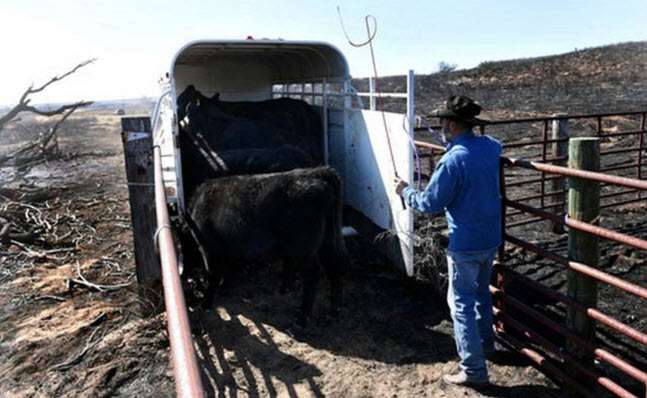
Gray County, Texas rancher Ron Ferguson loads cattle.
Photo: The Amarillo Globe News via AP Michael Schumacher
Plum Thicket farm, a 45,000-sow operation in Oklahoma owned by Smithfield Foods, suffered damages and animal losses because of the fire.
"While we are deeply thankful that no employees were harmed in the fire, we lament the unnecessary loss of animals and the devastation to the surrounding community,” company spokesperson Kathleen Kirkham said in a statement, according to Meatingplace. “We are continuing to assess the damage and are grateful for the efforts of local first responders throughout this situation."
Farmers in Kansas are also dealing with significant losses due to the fires.
“It’s pretty much a catastrophe,” Greg Gardiner, a rancher near Ashland, told the Associated Press, adding he's lost at least 500 cattle and more could perish. “It’s as bad as a mind can make it.”
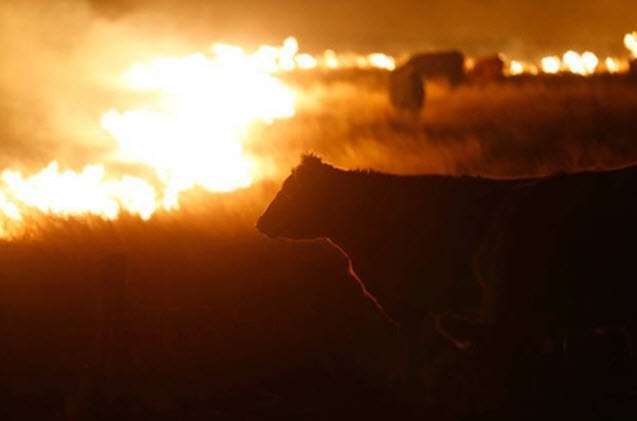
Cattle grazes near a wildfire in Protection, Kansas.
The Wichita Eagle via AP Bo Rader
Farmers assisting first responders
Wildfires are also causing havoc in Colorado, where barns, cattle and machinery have been lost.
But farmers are also using their machinery to help first responders.
Many farmers used their tractors to cut fire lines to keep the flames from spreading, according to the Denver Post.
“There (were) dozens of people out there with disks and tractors trying to get in front of (the fire),” Steven Meakins told the Post. “But it’s pretty scary when you’re in a tractor and you’re out in front of it and you can’t see the fire because of the smoke and dust. Your heart is racing.”
“This is what we do, us farmers,” Roland Barkey told the Post. “If you see smoke, you just get your rig and head to it.”
Ag community coming together to help their own
Tallian Thompson, a farmer from Midland County, Texas, is donating $30,000 of hay and auctioning a deer hunt in Stonewall County. All the proceeds from the auction will go towards helping families.
“I’d give them everything I got if I could but you just do what you can,” he told News West 9.
Many farm organizations in the impacted states have also set up ways to contribute financial, hay and other donations.