Diesel prices are expected to peak above $5.80 per gallon in April and average roughly $4.80 per gallon in 2026.
The U.S. Energy Information Administration (EIA) released its April Short Term Energy Outlook this week, outlining the far‑reaching consequences of the unprecedented closure of the Strait of Hormuz, a key chokepoint through which roughly one‑fifth of global petroleum and a significant share of liquefied natural gas exports normally flow.
According to EIA Administrator Tristan Abbey, forecasting under these conditions is unusually difficult. The agency is attempting to model an event that has no modern precedent: a complete shutdown of the strait and an uncertain timeline for its reopening.
“Our petroleum forecasts are highly contingent on the interaction of three variables,” Abbey said. “First, to even run our model we have to make an assumption about the duration of the Strait of Hormuz closure. Second, we know that the closure is forcing production to shut in, but we can only estimate these outages. Third, just as we had never before seen the strait close, we have never seen it reopen. What exactly that looks like remains to be seen.”
For agriculture, where fuel, transportation, and fertilizer costs play an outsized role in profitability, these uncertainties translate into real and immediate risk.
Millions of Barrels of Oil Taken Offline
The EIA estimates that restricted tanker traffic through the Strait of Hormuz has already resulted in massive oil production shut‑ins across the Middle East. Iraq, Saudi Arabia, Kuwait, the United Arab Emirates, Qatar, and Bahrain collectively shut in an estimated 7.5 million barrels per day of crude oil production in March. That figure is expected to rise to 9.1 million barrels per day in April.
In its base‑case forecast, the EIA assumes the conflict does not extend beyond April and that shipping traffic through the strait gradually resumes. Even under these relatively optimistic assumptions, production shut‑ins are expected to remain elevated at 6.7 million barrels per day in May and only return close to pre‑conflict levels by late 2026.
This prolonged reduction in available supply is a key driver behind higher energy prices now working their way through global markets.
Crude Oil Prices Remain Elevated Through 2026
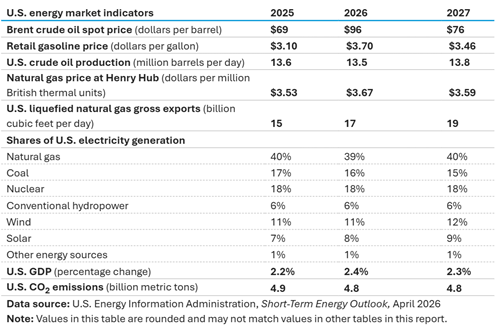
Brent crude oil prices averaged $103 per barrel in March. The EIA forecasts prices will continue rising, peaking at approximately $115 per barrel in the second quarter of 2026 before slowly easing as production comes back online.
Even as supplies normalize, the agency expects a sustained risk premium to remain built into oil prices due to lingering concerns about geopolitical stability and future disruptions. Under the EIA’s current outlook, Brent crude prices fall below $90 per barrel only by the fourth quarter of 2026 and average $76 per barrel in 2027.
For farmers, this means fuel costs are unlikely to return to pre‑conflict levels for several years, even if the immediate crisis subsides.
Diesel Prices Stay Especially Painful for Agriculture
Higher crude prices have already translated into significantly higher retail gasoline and diesel prices, with diesel posing the greatest challenge for agriculture.
The EIA forecasts that retail gasoline prices will peak near $4.30 per gallon this April and average more than $3.70 per gallon this year.
Diesel prices tell a more troubling story: they are expected to peak above $5.80 per gallon in April and average roughly $4.80 per gallon in 2026.
Diesel remains elevated due to tight global supplies and U.S. inventories that are still below the five‑year average. For farms reliant on diesel‑powered tractors, combines, irrigation pumps, grain dryers, and transport trucks, sustained diesel inflation directly raises per‑acre production costs.
LNG Disruptions Affect Natural Gas and Fertilizer Markets
The crisis has also disrupted global liquefied natural gas trade. Reduced LNG flows through the Strait of Hormuz have tightened global supply and driven a sharp price spread between U.S. natural gas benchmarks and higher‑priced European and Asian markets.
U.S. LNG export facilities are operating near record capacity, exporting nearly 18 billion cubic feet of natural gas per day in March, close to the all‑time high set in December 2025. With infrastructure already running flat out, there is little ability to increase exports further without new capacity or deferred maintenance.
While this limits how much U.S. gas prices can rise, it also keeps domestic markets tightly linked to global energy volatility.
Natural gas inventories ended the 2025–2026 withdrawal season at just over 1,900 billion cubic feet, about 3 percent above the five‑year average. The EIA expects storage injections to outpace historical norms and reach 4,015 billion cubic feet by October, roughly 6 percent above average, helping to cap price spikes later in the year.
What This Means for U.S. Farmers
For U.S. producers, the impacts will be felt most immediately through diesel costs. Spring planting, irrigation, and early‑season fieldwork coincide with the peak in forecast diesel prices, increasing upfront cash flow needs at a time when margins are already tight.
Livestock producers will also face higher feed transportation and processing costs, while grain farmers may see elevated basis levels as freight rates rise.
Fertilizer markets, heavily dependent on natural gas for nitrogen production, could remain volatile, particularly if global LNG disruptions persist longer than anticipated.
At the same time, strong U.S. LNG exports help support domestic natural gas production, which may prevent fertilizer prices from rising as sharply as diesel, offering some partial relief.
However, the overall message from the EIA outlook is clear: energy volatility is likely to remain a defining challenge for farm management decisions through at least 2026.
Planning for a High‑Cost Energy Environment
With so many variables still unresolved, including the duration of the Strait of Hormuz closure and the pace of oil flow restoration, farmers are operating in an environment where fuel prices remain an unpredictable risk factor.
Forward‑looking producers may look more closely at fuel budgeting, machinery efficiency, reduced field passes, and timing of input purchases. While no single strategy can offset global energy shocks, awareness and planning remain critical tools for managing their on‑farm impact.
As the EIA cautions, “Full restoration of flows will take months,” and until then, higher fuel prices are likely to remain part of the agricultural cost structure on both sides of the border.