Farms.com Home   Ag Industry News

Kuhn redesigns the Knight SL 100 Series manure spreaders

New design improves material breakup

By Diego Flammini
Assistant Editor, North American Content
Farms.com

Kuhn has redesigned its Knight SL 100 Series ProTwin Slinger manure spreaders.

“The all-new, fully adjustable shroud improves material breakup for more consistent, accurate spreading,” the company says on its website.

The spreaders come in capacities ranging from 1,000 gallon SL 100 to the 2,400 gallon SL 124. The spreaders have a wider discharge and can provide faster loading than its predecessor.
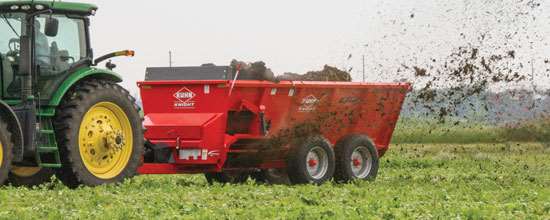
Kuhn knight

The Knights feature a welded V-body tank, capable of holding dry and wet materials. Steep, slanted sides and a twin-auger delivery provide a consistent and even flow.

The twin-auger design helps prevent material bridging. A raised right auger pushes materials rearward while the left auger pushes manure towards the discharge door.

An easy access drive compartment allows farmers to perform simple inspections of drive components and easy access for any additional maintenance. Gas-charged cylinders hold the lid in place and out of the way.

The undercarriage is designed to ensure intensive use in service and reliability in difficult conditions, even when transporting manure loaded with sand. The single axle configurations are available on SL models 110 and 114, while the SL models 114, 118 and 124 can be equipped with tandem axles.


Trending Video

Dicamba Returns for Georgia Farmers: What the New EPA Ruling Means for Cotton Growers

Video: Dicamba Returns for Georgia Farmers: What the New EPA Ruling Means for Cotton Growers

After being unavailable in 2024 due to registration issues, dicamba products are returning for Georgia farmers this growing season — but under strict new conditions.

In this report from Tifton, Extension Weed Specialist Stanley Culpepper explains the updated EPA ruling, including new application limits, mandatory training requirements, and the need for a restricted use pesticide license. Among the key changes: a cap of two ½-pound applications per year and the required use of an approved volatility reduction agent with every application.

For Georgia cotton producers, the ruling is significant. According to Taylor Sills with the Georgia Cotton Commission, the vast majority of cotton planted in the state carries the dicamba-tolerant trait — meaning farmers had been paying for technology they couldn’t use.

While environmental groups have expressed concerns over spray drift, Georgia growers have reduced off-target pesticide movement by more than 91% over the past decade. Still, this two-year registration period will come with increased scrutiny, making stewardship and compliance more important than ever.