Induction ceremony will take place March 8
By Diego Flammini
Assistant Editor, North American Content
Farms.com
Four deserving members of Middlesex County’s agricultural community will be enshrined in the Middlesex County Agricultural Hall of Fame during the Western Fair Farm Show on Wednesday, March 8.
The 2017 inductees are Richard Albert Gibson and Henry Noel Gibson, Dr. Donald Guest Grieve and Meredith Robb.
Richard Albert Gibson (1814 – 1911) and Henry Noel Gibson (1878 – 1966)
The Gibson family lived on Belvoir Farm near Delaware, Ontario – the farm was named after Richard’s father’s home in England. In 1880, Richard was appointed to the Ontario Agriculture Commission. In 1907, he became the first Canadian president of the American Shropshire Breeders Association and president of the Dominion Shorthorn Association.
Richard is a member of the Saddle and Sirloin Hall of Fame, which is associated with Chicago’s famed International Stock Show. He was also a writer for The Farmers Advocate.
Richard’s son, Henry, joined his father in the Saddle and Sirloin Hall of Fame in 1947. He was a well-known judge at the International Live Stock Exposition and the British Royal. He also served as president of the American Shropshire Association and spent time managing stock farms in the U.S. and Ontario.
Dr. Donald Guest Grieve (1934 – 2008)
Dr. Grieve was born in Westminster Township. He grew up on his family’s farm where he developed an interest for dairy farming and cattle management methods. Grieve graduated from the Ontario Agriculture College in 1955, majoring in animal husbandry. In 1962 he became an assistant professor in the OAC’s animal husbandry department. Grieve earned his PhD in dairy cattle nutrition from Cornell University.
He was a team leader on the Guelph/Ghana Project, which helped improve the education of teachers in Ghana, and contributed to research in the Netherlands on using "individual cow milk recording data at the start of lactation to predict the calving to conception interval."
Dr. Grieve served as chairman of the Department of Animal and Poultry Science at the University of Guelph from 1988 until his retirement in 1994.
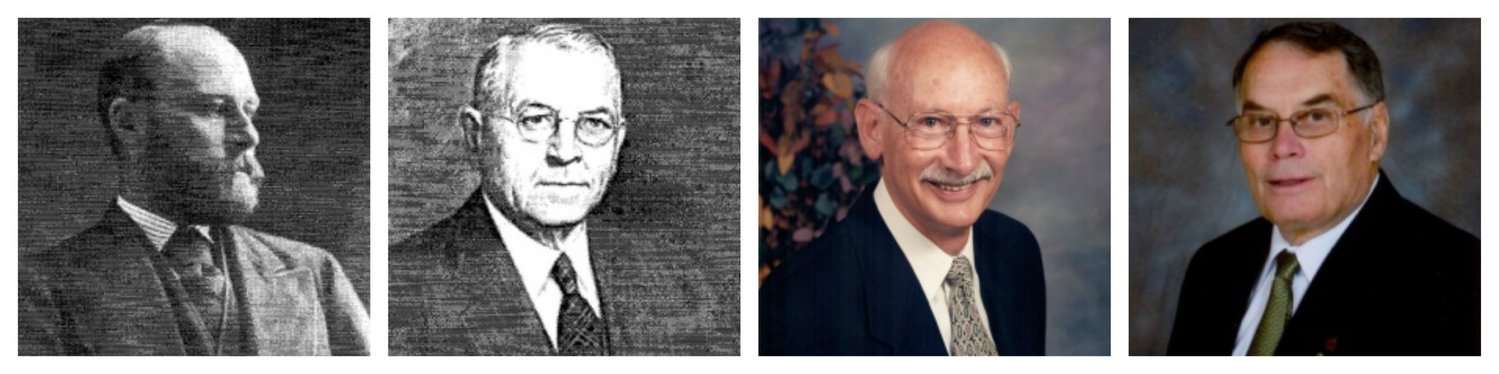
Left to right: Richard Gibson, Henry Gibson, Dr. Donald Grieve, Meredith Robb.
Meredith Robb (1940 – 2016)
Meredith Robb donated many hours to the Ilderton Agricultural Society, Home and Farm Safety Council, Federation of Agriculture, Pork Producers and 4-H. He graduated from the Western Ontario Agriculture School in 1958 and farmed on his great-great grandfather’s farm in London.
In 1974 he received a Nuffield Agricultural Travelling Scholarship. He spent six months studying agriculture in Europe.
Robb’s dedication to Junior Farmers led him to being a provincial director and delegate to Britain.
The inductees will be officially recognized at the Western Fair District on Wednesday, March 8 at 11:30 a.m. For tickets, call Hugh Fletcher at (519)-666-1572.