The project is a joint venture between the provincial government and Ontario Pork
By Diego Flammini
Staff Writer
Farms.com
The Ontario government is investing in research for the province’s swine industry.
On Tuesday, Agriculture, Food and Rural Affairs Minister Ernie Hardeman announced that a new swine research facility will be built at the Elora Research Station.
The $15-million project will be funded by the provincial government ($12 million through the Agricultural Research Institute of Ontario) and Ontario Pork ($3 million). The facility is in the design phase, which could take up to three years to complete.
Swine research will be relocated from the Arkell Research Station to the Elora Research Station upon completion of construction.
Once up and running, the new location be a hub for several types of research including housing, biosecurity, nutrient management and animal health.
“This new building will be a well-designed and state-of-the-art swine research facility that will ultimately give farmers the latest research findings, processes and technologies,” Minister Hardeman said during the announcement. “This will benefit their farm businesses and operations (and) it will help them become more efficient and sustainable, so they can be more profitable and more competitive.”
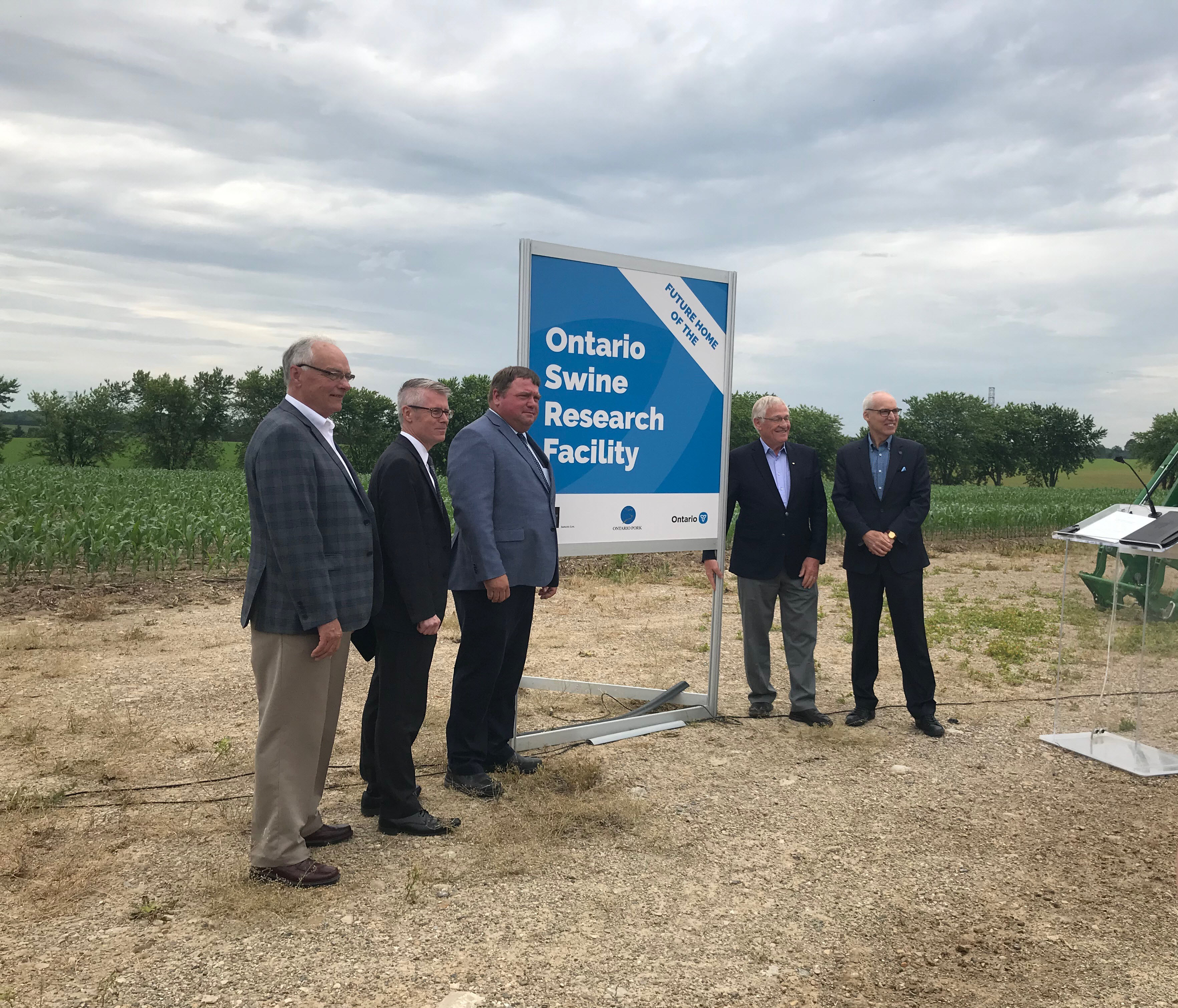
Left to Right: Randy Pettapiece (MPP - Perth-Wellington), Malcolm Campbell (Vice President, Research, University of Guelph),
John de Bruyn (Vice Vhair, Ontario Pork), Minister Ernie Hardeman and Franco Vaccarino (President, University of Guelph).
Pork producers are well aware of the important role innovation plays in operating a farm business.
The industry has witnessed several trends thanks to new research, said John de Bruyn, a pork producer from Oxford County and vice-chair of Ontario Pork’s board of directors.
“In 1975, there really wasn’t an artificial insemination industry,” he told Farms.com. “The whole industry was still using natural mating, and since that time we’ve pretty much gone to 100 per cent artificial insemination. That’s just one example of how the industry has changed over 40 years.”
Ensuring the new facility can accommodate the next 40 years of swine research will be important to its success, de Bruyn said.
Minister Hardeman also addressed the ongoing trade dispute between China and Canada.
Last week, China announced the suspension of all Canadian pork and beef imports after Chinese officials discovered ractopamine in a batch of pork.
The provincial government will continue to support local farmers until trade resumes, Hardeman said.
“Pork and beef are important to this province and we’re going to fight for our farmers, producers and packers, and everyone else involved in our meat sector until the issue is resolved,” he said during the announcement. “Last week, I spoke with the federal minister of agriculture (Marie-Claude Bibeau) to see how we can best support them in resolving this matter swiftly and support those important agriculture industries.”