These workers should be vaccinated during their quarantine period, a B.C. group says
By Diego Flammini
Staff Writer
Farms.com
International workers arriving in B.C. to work in the province’s ag sector should be early recipients of COVID-19 vaccinations, a migrant justice group says.
Communal housing presents challenges related to COVID-19 safety and puts migrant workers at a higher risk of becoming ill. That’s why the B.C. government should ensure these workers are vaccinated, said Robyn Bunn, a member of Radical Action with Migrants in Agriculture (RAMA).
“The workers have to live in the housing provided by their employers,” she told Farms.com. “There may not be enough space for social distancing, let alone isolation. So, when one person gets sick, everyone in the house gets sick.”
RAMA launched in 2013 to support and advocate for the migrant workers who travel to B.C. to work on farms.
In 2019, almost 11,000 workers, mostly from Mexico, worked on B.C. farms.
The B.C. government is set up to administer COVID-19 vaccines to migrant workers entering the country, Bunn says.
The provincial government is setting travelers up in hotels for their 14-day quarantines. Plus, a federal rule means anyone boarding a flight to Canada must show a negative COVID test.
The infrastructure is in place to get workers vaccinated before they arrive at their farm of employment, Bunn said.
“The workers take a pretty big risk to come to Canada to work on our farms, so we should be responsible in mitigating health risks,” she said. “The government knows where these (workers) are staying, so they could send people to the hotels to administer the vaccines while the workers are in their mandatory quarantine.”
Aside from the wellbeing of the temporary workers, on-farm concerns exist as well.
Some workers chose not to come to Canada last year. This put more pressure on the ag sector, Bunn said.
“There was a large number of workers who didn’t come because the risk was too great,” she said. “This left a lot of farmers scrambling to find solutions to get their harvests completed.”
B.C. recently announced Phase 2 of its COVID-19 vaccine immunization plan.
Representatives mentioned workers in processing plants may be eligible for the vaccine, but there was no specific talk of migrant workers, Bunn said.
B.C. officials continue to review its plan to determine the best course of action.
With Health Canada approving the AstraZeneca vaccine for use, this could provide opportunities for more people to receive vaccinations.
“As we mentioned when we launched the (immunization) plan, people between the ages of 18 and 64 who are front-line essential workers or work in specific workplaces or industries may be prioritized in our plan once additional vaccines were approved (beyond Pfizer and Moderna),” a provincial spokesperson told Farms.com in an email. “We will be providing a risk-based approach to those populations as we learn more about how much AstraZenca vaccine we are getting and when, and will be sharing more details about front-line essential workers and specific workplaces or industries in the coming weeks.”
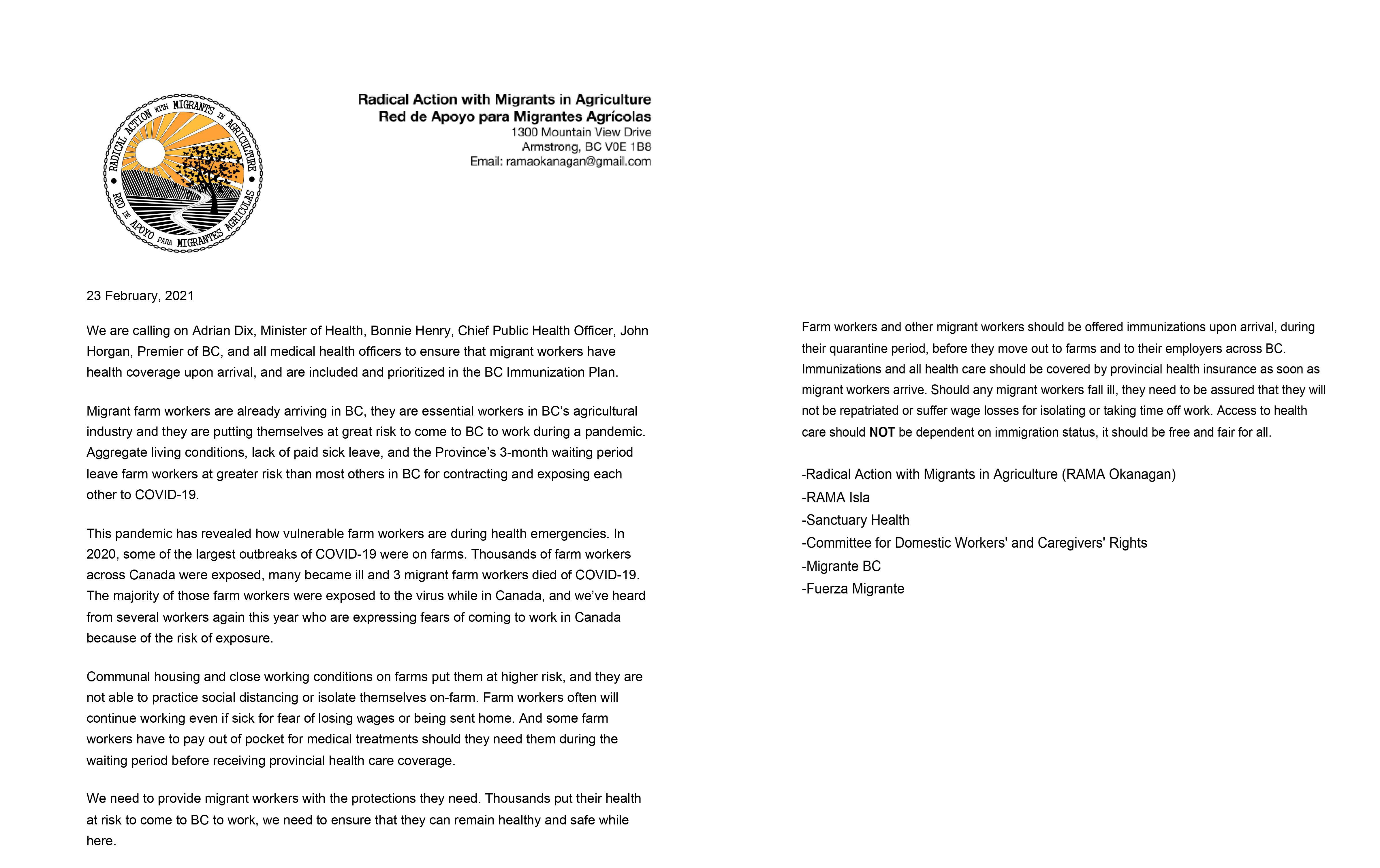
A letter from RAMA to the provincial government calling for migrant workers to receive COVID-19 vaccinations.