Farms.com Home   News

$1 Billion Success in Brazil For U.S. Wheat

U.S. Wheat Associates' education and engagement with millers in Brazil helped generate $1 billion in sales during the 2013/14 marketing year on a $100,000 investment. Read the full story here.
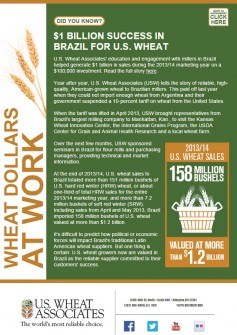


Year after year, U.S. Wheat Associates (USW) tells the story of reliable, high-quality, American-grown wheat to Brazilian millers. This paid off last year when they could not import enough wheat from Argentina and their government suspended a 10-percent tariff on wheat from the United States. 

When the tariff was lifted in April 2013, USW brought representatives from Brazil's largest milling company to Manhattan, Kan., to visit the Kansas Wheat Innovation Center, the International Grains Program, the USDA Center for Grain and Animal Health Research and a local wheat farm. 

Over the next few months, USW sponsored seminars in Brazil for flour mills and purchasing managers, providing technical and market information.

Click here to see more...

Trending Video

No-Till vs Tillage: Why Neighboring Fields Are World Apart

Video: No-Till vs Tillage: Why Neighboring Fields Are World Apart

“No-till means no yield.”

“No-till soils get too hard.”

But here’s the real story — straight from two fields, same soil, same region, totally different outcomes.

Ray Archuleta of Kiss the Ground and Common Ground Film lays it out simply:

Tillage is intrusive.

No-till can compact — but only when it’s missing living roots.

Cover crops are the difference-maker.

In one field:

No-till + covers ? dark soil, aggregates, biology, higher organic matter, fewer weeds.

In the other:

Heavy tillage + no covers ? starving soil, low diversity, more weeds, fragile structure.

The truth about compaction?

Living plants fix it.

Living roots leak carbon, build aggregates, feed microbes, and rebuild structure — something steel never can.

Ready to go deeper into the research behind no-till yields, rotations, and profitability?