By John Holman and Augustine Obour et.al
The results of the 2022 Kansas Performance Tests for warm-season annual forage varieties are available online at https://www.agronomy.k-state.edu/outreach-and-services/crop-performance-tests/forages/hay-and-silage/. The results are summarized by location (Garden City, Hays, and Scandia) and are split into hay and silage categories.
At this time, only the yield results are available for the warm-season varieties. Forage quality results will be posted soon.
Annual forage performance tests are conducted each year by the Kansas Agricultural Experiment Station (Figure 1). The objectives of these variety trials are to evaluate the performance of released and experimental varieties, determine where these varieties are best adapted, and increase the visibility of summer annual forages in Kansas. Breeders, marketers, and producers use data collected from the trials to make informed variety selections. The locations of the forage trials for 2022 were Garden City, Hays, and Scandia.
This work was funded in part by the Kansas Agricultural Experiment Station and seed suppliers. Sincere appreciation is expressed to all participating researchers and seed suppliers who have a vested interest in expanding and promoting annual forage production in the U.S.
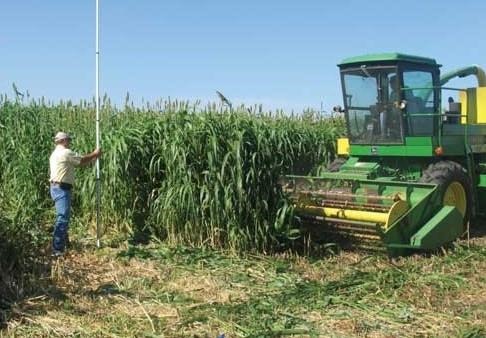
Figure 1. Harvesting a forage variety trial at the Southwest Research and Extension Center in Garden City, KS.
Source : ksu.edu