By DeAnn Presley
As we head into fall, some producers are thinking about seeding winter cover crops in fields currently planted to corn. The successful establishment of winter cover crops is influenced by several factors that are discussed in a K-State Research and Extension publication (Planting cereal rye after corn harvest ahead of soybean - https://bookstore.ksre.ksu.edu/pubs/MF3504.pdf). This article will provide some additional details about cover crop responses to various herbicides.
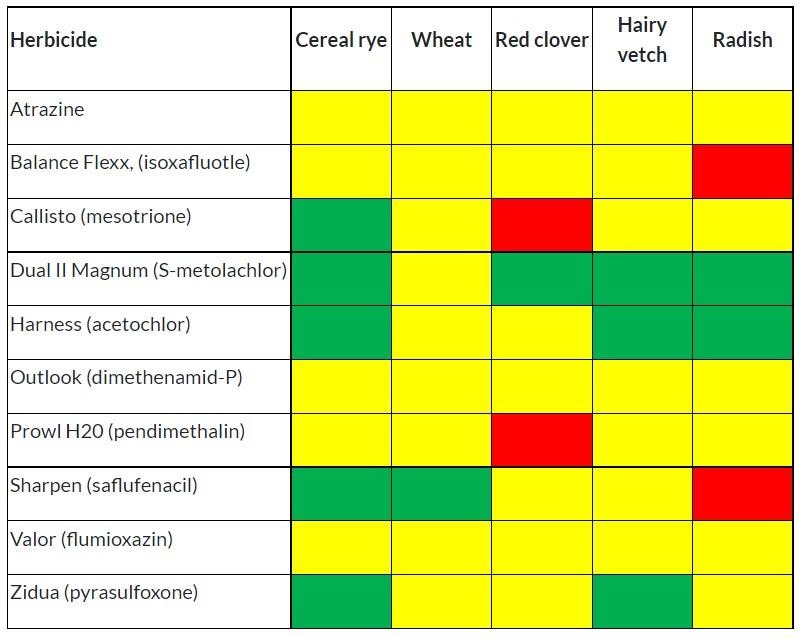
Cover crop response to herbicides will be influenced by a number of factors, including biological and biochemical characteristics of the plant, chemical characteristics of the herbicide, and weather conditions since herbicide application. Table 1 summarizes the response of selected cover crops to selected herbicides. For simplicity, no herbicide premixes are included in the list. The responses are cautious/conservative estimates based on published field research, herbicide labels, and a recent publication from the Take Action campaign. A field bioassay is the most reliable method to determine crop response to potential herbicide residues.
Table 1. Likelihood of injury to selected cover crops when planted in the fall after a spring application of selected corn herbicides. Green = injury unlikely; Yellow = injury possible; Red = injury likely.
The use of trade names is for clarity to readers and does not imply endorsement of a particular product, nor does exclusion imply non-approval. Always consult the herbicide label for the most current and update use requirements.
Source : ksu.edu