By Sarah Lancaster and Anita Dille et.al
Now is the time to begin considering how to terminate winter cover crops in preparation for summer crops. Some cover crop species, such as oilseed radish or fall-planted oats, are likely to be killed by freezing over the winter. But, many cover crops will need to be terminated by mechanical or chemical methods in the spring. Once the cover crop has been planted, there are two factors you can control in cover crop termination: method and timing, and choices related to these factors interact. It’s also important to remember that NRCS guidelines for termination timing have implications for program compliance (Figure 1).
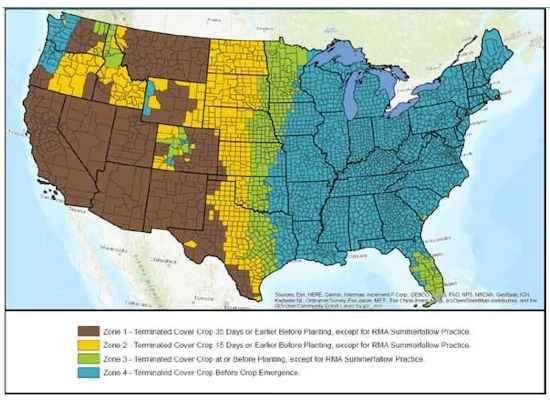
Figure 1. USDA’s map depicting termination timing guidelines.
Mechanical cover crop termination methods, such as rolling or roller-crimping (Figure 2), tillage, and mowing have the potential advantage of reducing selection pressure on herbicide resistant weeds by deferring herbicide use to in-crop applications. Termination with a roller or roller-crimper may be more effective for monoculture plantings of a winter cereal grain, such a cereal rye. Cover crop growth stage is a key factor in achieving a successful kill. For example, cereal rye and other winter cereal grains are most consistently killed when a roller-crimper is used at milk or dough stage, while legumes are best controlled at full bloom. Tillage is also a mechanical termination option in some cropping systems. Some species, especially clovers, may not be effectively killed by tillage. Multiple tillage passes may be required, which may cancel out soil health and conservation benefits of the practice. Mowing as a termination method is best suited to smaller acreages.
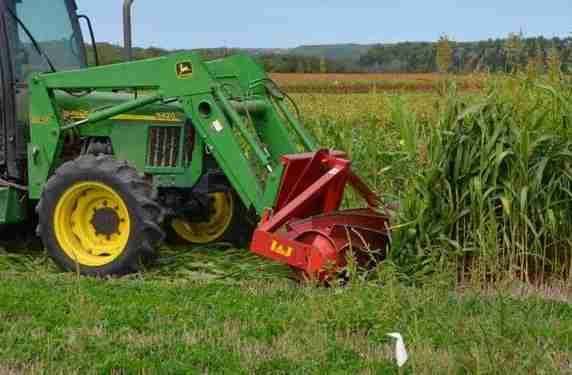
Figure 2. Roller crimper being used to terminate a sorghum-sudan grass summer cover crop.
Herbicides are an effective cover crop termination method that can be used in a variety of cropping systems. Selection of the most effective herbicide varies with cover crop species and growth stage. In general, more mature cover crops are more difficult to control with herbicides, especially once plants have begun reproductive development. Selective herbicides, such as SelectMax (clethodim) for grasses or 2,4-D for broadleaves can be used to control single-species plantings, but mixing Group 1 herbicides like clethodim with Group 4 herbicides like 2,4-D will likely reduce grass control. Non-selective herbicides such as glyphosate, glufosinate, or paraquat are recommended for control of mixed-species plantings. Combinations of glyphosate and 2,4-D can increase kill of broadleaf crops. Even though glyphosate is the most effective herbicide for control of most cover crop plantings, price and availability concerns for in 2022 may make alternative herbicides more appealing to some growers. Several herbicide options and their effectiveness are listed in Table 1.
Residual herbicides such as Prefix or Authority Maxx can also be used in cover crop termination sprays. Research by Whalen et al. in Missouri suggests that including a residual herbicide controls waterhemp and protects soybean yields better than chemical termination without residual herbicides. In this research, the mid-season waterhemp control was greater when the cover crop was terminated 21 days before planting than when the cover crop was terminated 7 days before planting, but termination timing did not affect soybean yield. If you choose to include an herbicide with residual activity, it is especially important to consider the potential for injury to the crop that will be planted afterward. When selecting an herbicide program to terminate your cover crop, it is important to consider possible restrictions (Table 1).
Additional resources for cover crop termination can be found at https://iwilltakeaction.com/news/cover-crop-fact-sheet-series.
Table 1. Herbicide considerations for chemical cover crop termination.
Herbicide | Termination effectiveness2 | Potential rotation restriction3 |
| Cereal rye | Austrian winter pea | |
Roundup PowerMax (glyphosate) | G/E | F/G | none |
SelectMax (clethodim) | G/E | N | corn |
Roundup + atrazine | G | G/E | soybean |
Roundup + Clarity (dicamba) | G/E | G/E | soybean |
Roundup + Canopy (chlorimuron + metribuzin) | F/G | G/E | corn |
Roundup + Sharpen (saflufenacil) | G/E | G | soybean |
Roundup + SelectMax (clethodim) | G/E | G | corn |
Roundup + 2,4-D | G/E | G/E | corn, soybean |
Gramoxone SL (paraquat) | F/P | F/G | none |
Gramoxone + atrazine | F | E | soybean |
Gramoxone + metribuzin | F | P | corn |
Gramoxone + 2,4-D | F/G | E | corn, soybean |
Gramoxone + dicamba | G | E | soybean |
Gramoxone + metribuzin+2,4-D | G/E | E | corn, soybean |
Gramoxone + metribuzin + 2,4-D + Classic (chlorimuron) | G/E | E | corn, soybean |
1Use of trade names does not indicate an endorsement of any product.
2E=excellent, G=good, F=fair, P=poor, N=none; Cover crop growth stage and environmental conditions will influence effectiveness. Herbicide labels supersede this information.
3Rotation restrictions are influenced by application rate and herbicide resistance in crop. Herbicide labels supersede this information.
The use of trade names is for clarity to readers and does not imply endorsement of a particular product, nor does exclusion imply non-approval. Always consult the herbicide label for the most current use requirements.
Source : ksu.edu