By Brad Buck
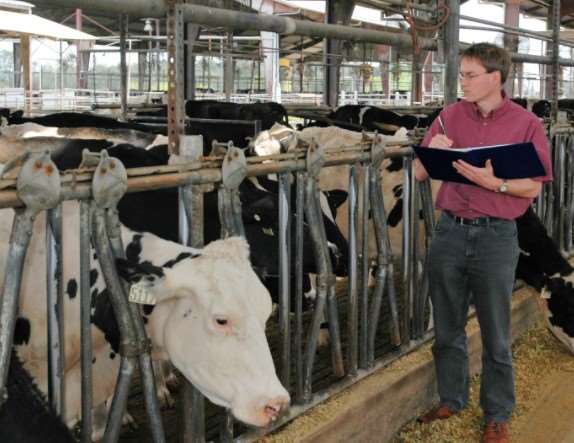
Cows and humans have something in common: If you take better care of the mother during pregnancy, her children are likely to be healthier – and this impact should last a lifetime, a University of Florida scientist says.
In the case of cows, cool conditions are key. A new UF/IFAS study shows calves conceived during winter went on to produce more calves and milk.
That’s a critical finding for dairy farmers and for people looking for a nutritious glass of milk because each Florida cow produces an average of 2,408 gallons of milk per year.
“This is important to figure out because maybe we can improve the conditions from conception on in order to get an animal to do as well as possible throughout its existence,” said Albert De Vries, a UF/IFAS associate professor of animal sciences. “The current thinking is that the environment plays an important role from at least conception on.”
Florida has about 124,000 dairy cows. For the study, researchers examined 667,000 cow lactation records for the years 2000 through 2012 from the Dairy Herd Information Association database. They obtained weather data from the National Oceanic and Atmospheric Administration. Scientists considered a heat and humidity index higher than 68 to cause heat stress in the cows.
Through these records, DeVries and lead author Pablo Pinedo, Colorado State University documented effects of heat stress during conception on the calf’s performance when it becomes a cow. They found that calves conceived in the cool season fared better from day 1 of their pregnancies. Researchers are now searching for the mechanisms that cause this effect, so they can provide management recommendations for dairy herds. “Perhaps we can do something during early gestation, even if the cow is under heat stress,” De Vries said.
"Two models were developed. Model A included the complete population of cows (n = 337,529 lactation records) created in winter or summer. Model B included cows (n = 228,257 lactation records) that had parent-average genetic information available to be able to correct for farmer’s use of lower genetic merit of sires in summer. Other variables included in the models were month and year of calving, age at first calving, and herd. Models were run per parity group (1, 2, and ≥3). In both models, age at first calving was lower for cows created during winter versus summer. The odds (95% confidence interval) of survival to a second calving for cows created in winter were 1.21 and 1.15 times the odds of survival for cows created in summer for models A and B, respectively. Numbers of days from calving to first breeding and from calving to conception were consistently smaller for winter versus summer months of creation across all parity categories. Milk yields (305 d and by 70 d in milk) were greater for winter versus summer. In conclusion, cows that were created in the winter had better subsequent survival and performance than cows that were created in the summer. There is evidence that season of creation may have lifelong negative consequences for the cow. Season of creation is associated with future survival, fertility, and milk yield of Holstein cows"
Source: ufl.edu