By Sara Bauder
Corn and soybeans are warm-season crops, meaning they prefer to grow during the warmest part of the year. When spring-season temperatures are cool, row crop germination comes to mind. To get ahead of the game, many farmers will plant their corn and soybeans earlier than recommended, but how early is too early?
Research has shown that the three-day average soil temperature for corn to germinate must be at least 50°F. However, temperatures of 60-70 degrees typically allow for more-uniform germination across a given field. Corn planted before soil temperatures reach a minimum of 50°F may be much slower to germinate and come up less uniformly.
Soybeans tend to like temperatures a bit warmer than corn, with a required three-day average soil temperature of 55°F or higher for uniform germination. The recent trend toward earlier soybean planting has shown that soybeans may germinate in soils as cool as 50°F, but it is not ideal, and it may cause stands to be less uniform than desired. The “ideal” soil temperature for soybean germination is much higher at 77°F.
Understanding Early Planting Risks
One of the biggest concerns for row crops planted into cool soils is chilling injury. Corn and soybeans both go through an imbibition period, which occurs when moisture hits the seed right after planting. They tend to be quite susceptible to cold, wet soils during this time. If that initial water is colder than 50°F, seeds may become swollen and non-viable due to cell rupture; roots and shoots may be aborted. This risk is heightened when seeds are planted into dry, cool soils and a cold rain occurs afterward. Corn that is seeded into wet soils with temperatures above 50°F within the first 48 hours following planting should germinate just fine. Soybeans have a shorter imbibition period, and soil temps above 50°F for 24 hours is usually long enough for acceptable germination.
If crops are planted early and germinate as expected, of course, there are still a few temperature-related risks to consider. If the air temperature drops into the 40s for several days, emergence will likely be significantly slowed, meaning crops may take two weeks or longer to emerge depending upon accumulated growing degree-days. When seeds sit in cool, wet soils, soil pathogens have an opportunity to affect seedlings, making seed treatments an important form of protection. Other early-season soil and environmental conditions, such as crusting, compaction and herbicide injury can also compound with pathogens, creating additional issues.
Monitoring Soil Temperatures
Checking soil temperatures and developing a three-day average can be a challenging job. The South Dakota Mesonet weather station network collects this data for growers all across South Dakota. Soil temperatures are measured at 5 depths, with the shallowest depth being 4-inches (under bare soil). The Mesonet is updated every 10 minutes and provides daily averages. To find the Mesonet station nearest you, visit the Mesonet at SDState website. On the website, there is an interactive map where you can select 24-hr Soil Temp, 4” Bare to view the bare soil temperatures across the state (Figure 1).
Although it can be tempting to get a head start with row crops, be mindful of soil temperatures and the risks associated with planting early.
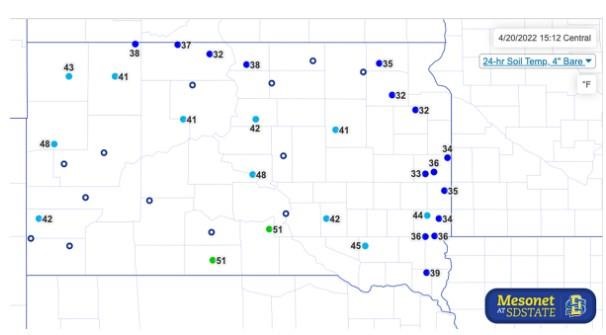
Figure 1. Bare soil temperature at 4-inch depth on April 20, 2022.
Source : sdstate.edu