John Deere offers a wide array of electronic display solutions to help customers get the job done out in the field, and the company never cuts corners when it comes to quality. For this reason, customers can rest assured that they’re always getting the best value for their dollar, especially when it comes to the company’s technology offerings. With John Deere Electronic Solutions displays, the possibilities on the worksite are endless.
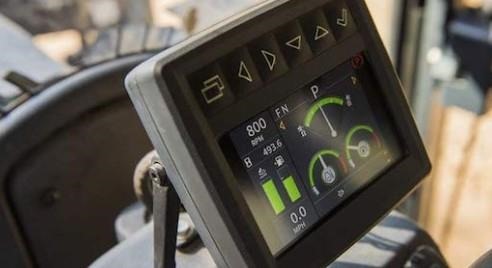
John Deere Electronic Solutions Offerings
The range of solutions available begins with a simple configuration that includes basic icons and expands into larger, reconfigurable, and customizable displays to accommodate specific applications. By offering a wide range of options, Deere ensures that it is able to fit any and all platforms. Because of this, customers are also less likely to run into a situation where their machine is equipped with a system they will never need.
Let’s take a look at the specific series that Deere offers, as well as their various features.
DR8 Series
This electronic display solution has 12V/24V system voltage and a Molex MX150, 12-way machine interface connector. It also features an internal speaker, as well as a digital video input via ethernet for the utmost connectivity. The user interface itself is a touchscreen, and the display will work in temperatures ranging between -30 degrees Celsius and 70 degrees Celsius. It has 256MB of RAM, as well as an NXPi.MX6 microprocessor.
DR7 Series
Similar to the last system, the DR7 Series has a system voltage of 12V/24V and can operate in temperatures between the same -30 to 70-degree Celsius range. It has a Delphi GT-150, 14-way machine interface connector, and uses a J1939 CAN system for vehicle communications. There are two NTSC video inputs and a 32-bit softcore microprocessor. The user interface features six buttons and a touchscreen for ease of use, and the display has 256MB of RAM.
Click here to see more...