By Vasudha Sharma
The last few irrigations of the season are as critical as the first ones to obtain optimum crop yield. Excess water in the crop root zone later in the season beyond maturity could result in yield loss and therefore reduced profits. Though it is important to provide adequate soil moisture in the root zone to carry the crop to maturity without reducing yields, the soil moisture can be depleted up to 60-70% of available water when nearing maturity, which will minimize the water supply needs, fuel and labor for the season, allow the off-season precipitation to recharge the soil profile and reduce the potential for leaching nutrients below the root zone. An additional benefit of maintaining low soil moisture at the end of the season is reducing harvest delays due to muddy soil conditions.
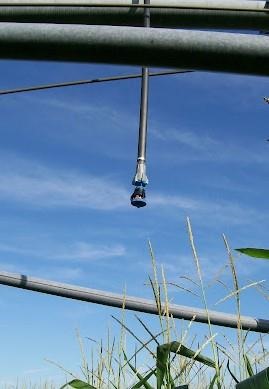
For irrigation management late in the season, you will need to know the current crop growth stage and predicted crop maturity date, predicted rate of water use by the crop to maturity, remaining useable water in the root zone and the probability of significant amounts of rainfall before crop maturity. Detailed information about crop growth stages and water use to maturity for both corn and soybean is presented here: z.umn.edu/LastIrrigation.
Corn and soybean plants require some moisture right up to the time of maturity. However, with shorter and cooler days towards the end of the season, the crop is using less water and thus requires less water than the rest of the season per day. For example, the corn water use or crop evapotranspiration (ET) has changed from an average of 0.3 inches/day at silking in late July and early August to 0.15 inches/day in early September. Other crops also experience this drop in crop water use as well. The water requirement to reach maturity for corn and soybeans is presented below in Table 1.
Table 1. Estimated normal water requirements for corn and soybeans between various growth stages and maturity in central Minnesota
| Growth stage | Approximate number of days to maturity | Water use (ET) to maturity (inches) |
|---|
| Corn | | |
| Blister (R2) | 50 | 7 |
| Milk (R3) | 40 | 4.7 |
| Dough (R4) | 28 | 2.5 |
| Beginning dent (R4.7) | 24 | 2 |
| Full dent (R5) | 20 | 1.5 |
| 1/2 milk line (R5.5) | 13 | 0.8 |
| 3/4 milk line (R5.75) | 7 | 0.3 |
| Soybean | | |
| Full flowering (R2) | 51 | 7.25 |
| Full pod (R4) | 37 | 4.4 |
| Beginning seed (R5) | 29 | 2.9 |
| Full seed (R6) | 17 | 1.2 |
| Beginning maturity (R7) | 10 | 0.4 |
From Table 1, the corn crop needs 2.5 inches of water from the dough (R4) stage to reach maturity. If the crop is at the dough stage right now and the soil water in the corn root zone is equal or more than 2.5 inches, no more irrigation is needed. To estimate or measure the current soil water in the root zone, soil moisture sensors can be used: z.umn.edu/Moisture-Sensors-Irrigation.
Table 2 represents an example of estimating the last irrigation requirement.
Table 2. Estimation of the last irrigation requirement form.
| Steps | Example 1 | Example 2 | Your field |
|---|
1. Date
Field
Crop
Soil type
Crop growth stage | Test 1
Corn
Esterville sandy loam
Dough | Test 2
Soybean
Dakota loam
Beginning seed | |
2. Water use to crop maturity (WUCM)
(Table 1) | 2.5 | 2.90 | |
3. Allowable soil moisture deficit (ASMD)
(Table 5) | 1.5 | 3.45 | |
4. Current soil moisture deficit (CSMD)
(measured) | 0 | 0.50 | |
5. Remaining usable water (RUSM)
(Step 3 minus Step 4) | 1.5 | 2.95 | |
6. Irrigation water requirements in inches (IWR). Assumes no rain.
(Step 2 minus Step 5) | 1 | 0* | |
| *If line 5 is greater than or equal to line 2, no more irrigation is needed. |
Source : umn.edu