By Adityarup "Rup" Chakravorty
Cowpea is an important crop in many parts of the world, especially sub-Saharan Africa. It is resilient and can grow in areas with little rainfall and low-quality soils. But as hardy as it is, cowpea yields can decrease by drought and low levels of soil phosphorus.
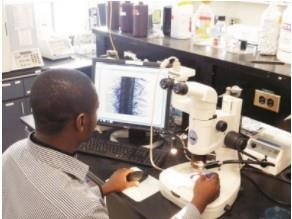
Researcher Saba Mohammed captured root hair images from seedling root samples of cowpea plants at the Rootlab at Pennsylvania State University. The samples were grown on germination papers and imaged with the aid of a camera mounted on a dissecting microscope. Examining roots of cowpea seedlings can help identify root features in mature plants that are beneficial for growth in challenging environments.
In a recent study, researchers determined cowpea root characteristics that could help the plants grow better in drier, low-phosphorus soils.
“Developing cowpea varieties that can produce optimally under stressful conditions is vital,” says Saba Mohammed, lead author of the study at Ahmadu Bello University in Zaria, Nigeria. “These resilient cowpea varieties can help make more people food and nutrition secure.”
The study was published in Crop Science, a publication of the Crop Science Society of America.
Cowpeas are a key source of calories for millions of people across the world. They are rich in protein and other nutrients. Cowpea plants also have a variety of other uses. They can serve as animal fodder and green manure.
Microbes in cowpea root nodules can increase soil fertility. These microbes make atmospheric nitrogen available to plants in the soil – a process called nitrogen fixation. Nitrogen fixation can be beneficial for farmers who cannot afford nitrogen-based fertilizers.
Most cowpea production is in semi-arid regions. Harsh environmental conditions and poor soils often hamper yields. “Our work established that certain root characteristics increased the yield of cowpea plants under drought or low soil phosphorus conditions,” says Mohammed.
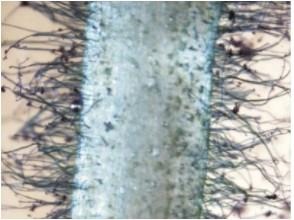
A high-resolution root hair image taken from a cowpea seedling root sample. The image was taken after 14 days of growth on germination papers. Root hairs play important roles in cowpea tolerance to drought and poor soils.
These root features include longer primary roots and higher numbers of lateral roots emerging from primary roots. Root hairs also play important roles in cowpea tolerance to drought and poor soils.
For example, cowpea plants with longer, denser root hairs had higher yields when grown in low-phosphorus conditions. “That suggests these root hair features play crucial roles in acquiring phosphorus from sub-optimal soils,” says Mohammed.
Scientists have long known that roots are a key part of how plants adapt to difficult environmental conditions. “The root system is half of the whole plant system,” says Mohammed. “Yet, it has been relatively under-explored in finding solutions to farming constraints.”
Root systems have diverse strategies for extracting resources from soil. “For instance, plants with deeper roots produce better than those with shallow roots under limited-water conditions,” he says. “On the other hand, those with shallow roots may be more suited to soils with suboptimal nutrients.”
That’s because nutrients – like phosphorus – are often concentrated in the top layer of soil.
Click here to see more...