Farms.com Home   News

Has the adoption of genetically engineered (GE) crops resulted in more herbicide resistant weeds in Ontario?

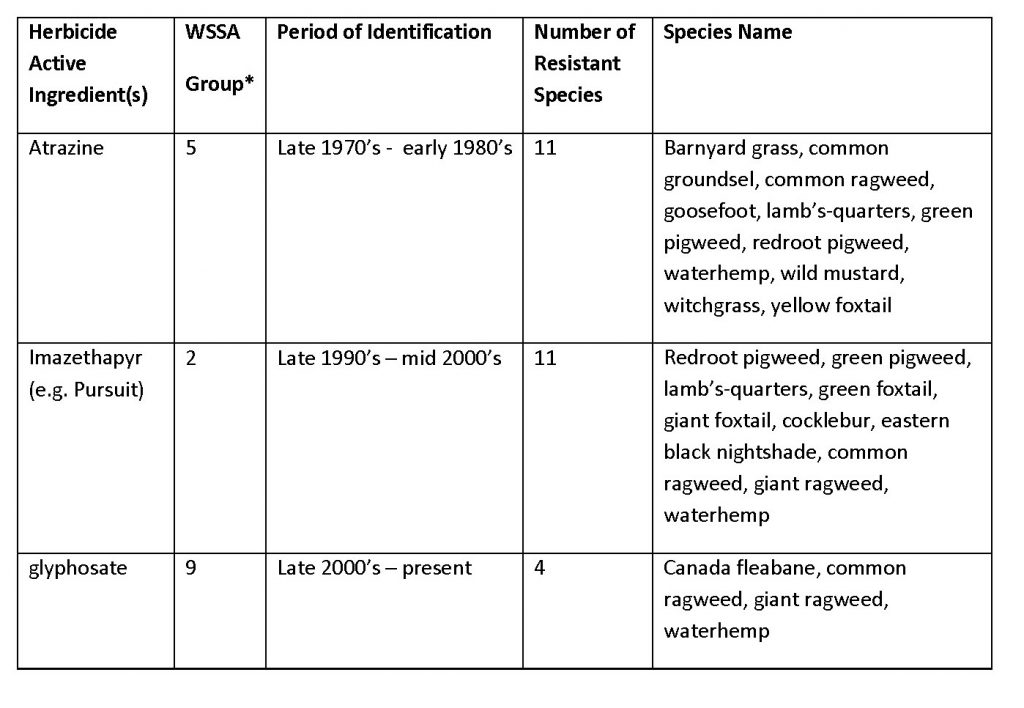
The increased acreage of genetically engineered (GE) crops planted in Ontario has not led to an increase in herbicide resistant weeds according to results from the University of Guelph’s testing laboratory. Table 1 summarizes the number of species confirmed as resistant to common herbicides used in Ontario over the past 40 years. There are currently fewer species resistant to glyphosate, known commonly by the trade name “Roundup”, a herbicide used to control weeds in specific GE soybean and corn cultivars compared to other herbicide active ingredients that have been used to control weeds in non-GE corn and soybean cultivars. The one constant regardless of growing GE cultivars with specific herbicide tolerance traits or non-GE cultivars, is the selection of the herbicide resistant weed population. When introduced into the marketplace, all three herbicides listed in Table 1 were very effective at controlling a wide range of weeds and because of that they were used frequently on many acres and over multiple seasons. This imposed a high selection pressure within a cropping system which found populations that could survive the herbicide application, produce seed and become established. History has repeated itself with glyphosate in that some of the first sites with confirmed resistant species had a history of a limited crop rotation and exclusively using glyphosate to control weeds from year to year.

Table 1 Number of weed species resistant to three commonly used herbicide active ingredients in Ontario field crop production.
In the short term, if you are affected by herbicide resistant weeds, you can manage them by tank-mixing other herbicide with different modes of action. The pestmanager app (www.pestmanager.ca) allows you to search for herbicides that will control a resistant weed species (Figure 1).

In the long term, we must make the environment unpredictable for weeds by growing diverse crop rotations and cover crops, using tillage, and emerging technologies like harvest seed destruction and robotics so that we have a more resilient weed management system. Easy to say, hard to do.

Further reading: Often the term “superweed” is used when talking about herbicide resistant weeds in GE cropping systems. I have chosen not to tackle that topic since I biased in this regard. I believe that all weeds are super. However, Dr. Andrew Kniss (University of Wyoming) has written a thoughtful piece on this topic.


Source: FieldCrop


Trending Video

Will the 2025 USDA December Crop Report Be a Market Mover/Surprise?

Video: Will the 2025 USDA December Crop Report Be a Market Mover/Surprise?


Historically, the USDA December crop report is a non-event or another dud report as the USDA reserves any final supply changes to the final report in January of the following year in this case 2026. But after the longest U.S. government shutdown in history at 43 days and no October crop report will they provide more data/surprise and make an exception?
Our China U.S. soybean purchase tracker is now at 26.6% or a total of 3.2 mmt but for traders it’s taking too long to unfold.
The final Stats Canada production report was bearish canola and wheat projection a record crop in both (it adds to the global glut of supplies) and bullish local corn and soybean prices in Ontario/Quebec thanks to a drought. It will not help the fund flow short-term, the USDA may need to offset it?
A U.S. Fed interest rate cut of another 25-basis point next Wednesday (probability 87.1%) could help fund flow and sentiment in stock and ag commodities into year end.
More inflows into Bitcoin this past week saw prices rebound back above 90,000 with support at 82,000 and resistance at 96,000.
A V-shaped bottom in cattle suggest the lows are in after Mexico reported another new world screwworm case. Lower weights, seasonal demand and higher U.S. beef select/choice values with a continued closure of the Mexican border to cattle will result in a resumption of higher cattle futures into yearend.
Australia is expected to produce its 3rd largest wheat crop ever at 36 mmt adding to the global glut of supplies.
Reports of ASF in hogs in Spain the largest pork exporter in Europe could see the U.S. win more pork export business long-term.
If the rains verify into next week of 3-5 inches for Brazil it would go a long way to fixing the dry regions from the last 2-months, but the European weather model has been wrong for the past 2-months!
Natural gas futures are surging to the 3rd price count as frigid hold temps set in.
CDN $ is also surging to end the week on a very resilient economy and better employment numbers suggesting no interest rate cuts next week.
Finally, the CFTC report showed funds were net buyers of soybeans but sellers of corn, canola and wheat. In real time the funds have gone back to selling as they take some profits.