By Melissa Elischer
Have you ever looked at a dairy cow and wondered about the history of the breed? Michigan State University Extension will explore the history of the seven major breeds of dairy cattle in the U.S. Holstein cattle were the first in the series, followed by Jerseys and Ayrshires, Guernseys and Brown Swiss. The sixth breed to be discussed is Milking Shorthorns.
In contrast to other dairy cattle breeds, Shorthorns originated as a dual purpose breed, meaning they were used for both milk and meat. As the genetic focus of cattle split to specialize in either beef or dairy production, different breeding lines were also established.
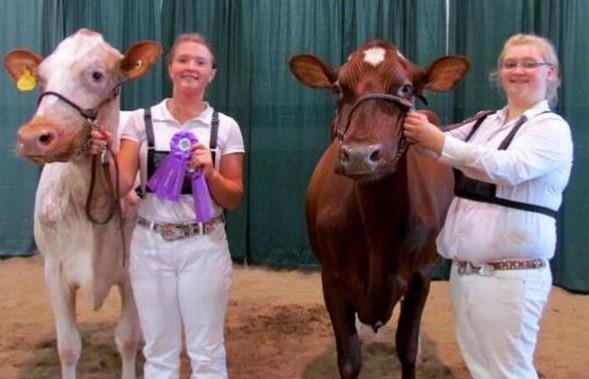
Like Jersey, Ayrshire and Guernsey cattle, Milking Shorthorns originated in the United Kingdom. Milking Shorthorns were first developed along the Tees River in the norther part of England. Although references to cattle with “short horns” can be found as early as 1600, the breed did not see its modern roots until the late 1700s. Two brothers, Robert and Charles Colling, were selectively line breeding to improve the native Durham cattle. The brothers had four superior cows and one bull that were the start of their genetic line. In addition to the Collings, two other men were refining another native cattle breed. Thomas Bates and John Booth were selectively breeding Teeswater cattle; Booth worked to improve the beef quality of Shorthorn cattle, while Bates was focused on the dairy characteristics of the breed.
Shorthorns were first introduced in the United States in 1783 in Virginia and became a very popular breed for settlers because of the cattle’s versatility and calm disposition. They spread quickly throughout the country and can be found in nearly every state today, and they’re popular in England, Canada and Australia.
Milking Shorthorns are known for their structural soundness, calving ease, long production life and feed efficiency. Milking Shorthorns coat colors include white, red and road, which is a color that is a very close mix of red and white. Milk from Shorthorn cows averages 3.8 percent fat and 3.3-3.5 percent protein. Also, the breed has one of the lowest average somatic cell scores in the U.S. and Canada.
There are numerous organizations for Milking Shorthorn breeders around the world, many of whom also have junior or youth organizations. To learn more about Milking Shorthorns in the U.S. and around the world, visit the following websites:
- American Milking Shorthorn Society
- Canadian Milking Shorthorn Society
- Dairy and Beef Shorthorn, United Kingdom
- Dairy Shorthorn Association of Australia
- Purebred Dairy Cattle Association
- Oklahoma State University – Breeds of Livestock
Michigan State University Extension and the Michigan 4-H Youth Development program help to create a community excited about STEM (Science, Technology, Engineering and Mathematics). 4-H STEM programming seeks to increase science literacy, introducing youth to the experiential learning process that helps them to build problem-solving, critical-thinking and decision-making skills. Youth who participate in 4-H STEM content are better equipped with critical life skills necessary for future success. To learn more about the positive impact of Michigan 4-H youth in STEM literacy programs read our 2015 Impact Report: “Building Science Literacy and Future STEM Professionals.”
Other articles in this series:
- History of dairy cow breeds: Holstein
- History of dairy cow breeds: Jersey
- History of dairy cow breeds: Ayrshire
- History of dairy cow breeds: Guernsey
- History of dairy cow breeds: Brown Swiss
Source:msu.edu