Can trees adapt to (climate) change? Which trees are more or less capable of doing so, and why? A group of researchers from all over the world set to work on these questions. Professor of Environmental Biology Peter van Bodegom helped to classify the functional traits of tree species, including, for example, the thickness of the bark, the height of the trunk and the construction of the leaf. Thanks to a statistical analysis of the characteristics of 50,000 tree species, researchers can now see which characteristics vary together. The results have been published in the journal Nature Communications.
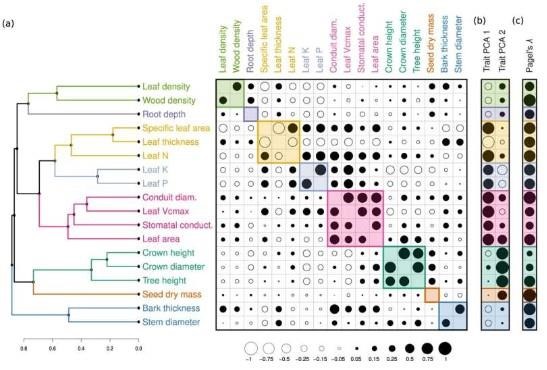
Trait correlations and functional clusters.
To determine which characteristics of tree species often occur together and what this implies, about 30 scientists from 16 different countries worked together. Researchers in Brazil, the Netherlands, Austria, Switzerland and even Russia and New Zealand classified the traits of tree species. The focus was on eighteen functional traits, including leaf, seed, bark, wood, crown and root properties. On this basis, the researchers created the largest database in the world containing 50,000 tree species.
Van Bodegom also supplied data for the extensive database and contributed to the development of the analytical methodology. "We based the database on the field measurements of a large network of researchers. They have measured the properties of tree species in fields and forests using similar protocols. Everything is stored in a central database. Then we analyzed that database statistically to identify patterns in the traits."
Cluster of traits that occur together
From this analysis, the researchers can see which traits of trees often occur together and how these traits influence each other. From this, the researchers identified eight different clusters. Each cluster reflects a unique aspect of the tree's shape and function. "For example, we see a cluster of properties that all have to do with how the tree deals with water or light. In the light cluster, for example, the height of the tree and the diameter of the crown are an important set of properties that are related."
Besides the obvious result that coniferous (or needle-bearing) trees behave differently from deciduous trees, it also shows which clusters of traits often come together. "Some of these clusters had never been demonstrated on a global scale before. This shows, for example, that in addition to competition for light, adaptation to drought and fire are also very important traits."
Click here to see more...