Farms.com Home   News

Hunting for Stalk Borers

By Erin Hodgson

While in westcentral Iowa yesterday setting up some small plot experiments, I got distracted by a long stretch of grass alongside a cornfield. I noticed some “deadheads” among the green plants and decided to dig a little deeper.
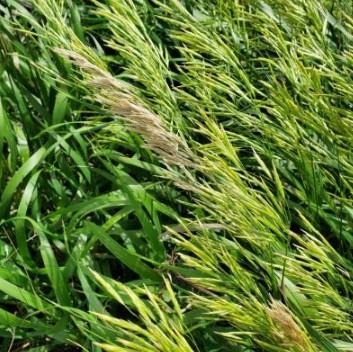
Hunting for stalk borers

I pulled up some of the dead head plants and noted holes about half-way down the plant.
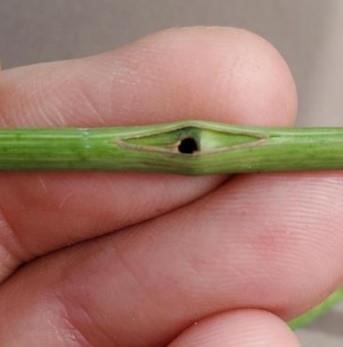
Hunting for stalk borers

I used a knife to spilt the stalk just above the hole and a very unhappy caterpillar was inside.
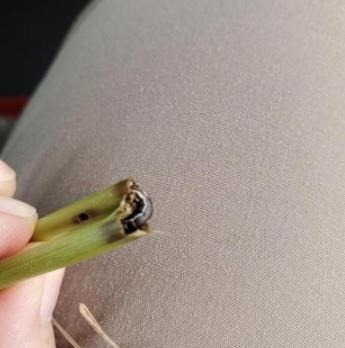
Hunting for stalk borers

The caterpillar, known as common stalk borer, was about an inch in length and had a purple “saddle” on the thorax and an obvious orange head. Yes, I am taking donations for a moisturizing hand cream!
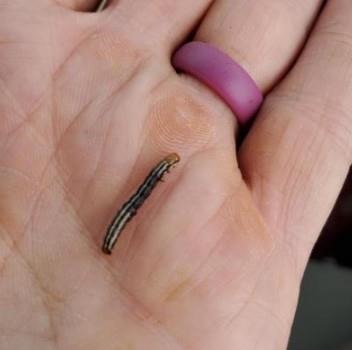
Hunting for stalk borers

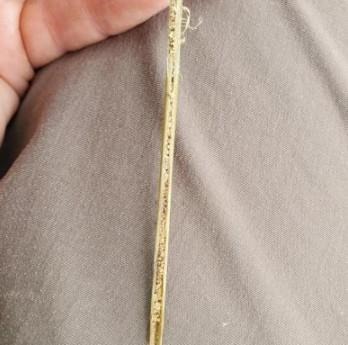
The caterpillar pretty much filled up the inside of the stem and had created copious amounts of sawdust-like frass.
Hunting for stalk borers

Based on accumulating degree days estimated by a recent ICM News article, I would expect stalk borers to move to corn and soybean in central Iowa next week. The only time to act is when the caterpillars are exposed, moving from grass to crops. Take a look at field edges now, especially in areas with previous stalk borer infestations.

Source : iastate.edu

Trending Video

Seeing the Whole Season: How Continuous Crop Modeling Is Changing Breeding

Video: Seeing the Whole Season: How Continuous Crop Modeling Is Changing Breeding

Plant breeding has long been shaped by snapshots. A walk through a plot. A single set of notes. A yield check at the end of the season. But crops do not grow in moments. They change every day.

In this conversation, Gary Nijak of AerialPLOT explains how continuous crop modeling is changing the way breeders see, measure, and select plants by capturing growth, stress, and recovery across the entire season, not just at isolated points in time.

Nijak breaks down why point-in-time observations can miss critical performance signals, how repeated, season-long data collection removes the human bottleneck in breeding, and what becomes possible when every plot is treated as a living data set. He also explores how continuous modeling allows breeding programs to move beyond vague descriptors and toward measurable, repeatable insights that connect directly to on-farm outcomes.

This conversation explores:

• What continuous crop modeling is and how it works

• Why traditional field observations fall short over a full growing season

• How scale and repeated measurement change breeding decisions

• What “digital twins” of plots mean for selection and performance

• Why data, not hardware, is driving the next shift in breeding innovation As data-driven breeding moves from research into real-world programs, this discussion offers a clear look at how seeing the whole season is reshaping value for breeders, seed companies, and farmers, and why this may be only the beginning.