UC Davis equine clinicians and researchers currently learn a great deal from each other’s disciplines, but rarely work hand-in-hand on horses presented for evaluation of lameness or other gait abnormalities. Researchers utilize test horses to study movement and often analyze data from hundreds of past patients to determine injury patterns. Clinicians attempt to objectively detect lameness issues, sometimes utilizing sophisticated video equipment, but more often using only the naked eye, supplemented by ancillary procedures such as local anesthetic nerve or joint blocks and diagnostic imaging techniques. The future of equine research and care at UC Davis seeks to blend those two worlds into the most up-to-date performance center anywhere in veterinary medicine.
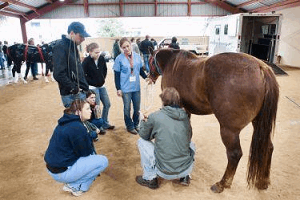
Plans for a state-of-the-art arena as part of a future veterinary medical center hold the potential to take sport horse care at UC Davis to a new level. The small size of the veterinary hospital’s current arena, as well as its surface, limit the ability to evaluate certain injuries or performance issues of top athletes, particularly those issues that are apparent only when the horse is ridden. The arena lacks the proper area in which to ride a horse, and is not equipped with any fixed cameras to capture images of the horse in motion, thereby limiting the veterinarians’ abilities to assess subtle gait abnormalities that may reflect early injury.
“We can objectively assess an athlete’s condition fairly accurately in our current setting,” said Dr. Sarah le Jeune, chief of the Equine Integrative Sports Medicine Service. “However, certain injuries only become apparent when the horse is ridden, and we are currently missing this piece of information due to our small arena.”
Observing a horse under saddle, performing the complex movements associated with its discipline, before and after diagnostic nerve blocks, can greatly improve the accuracy of an examination and the resolution of the problem at hand.
Plans for a new arena—slated to be more than three times the size of the current arena—call for room to see horses perform and to conduct under-saddle lameness evaluations. The arena will also be equipped with high-speed motion capture cameras (currently utilized by researchers) to help detect subtle gait abnormalities. Veterinarians need extremely high speed cameras to properly evaluate movement of the distal limb of a horse. The proposed cameras measure more than 1,000 frames per second, and can help to detect subtle injuries at an early stage or to find the optimal movement pattern in order for a horse to perform at its highest potential.
The school’s Gait Analysis Laboratory—providing sophisticated kinematic analyses for objective measures of horse’s gait and the efficacy of treatment of a musculoskeletal injury or disease—will be integrated into the arena and adjacent trotting lane. A force plate to help determine distribution of weight bearing throughout all four limbs will be embedded in the trotting lane. Adding to the efficiency of the new set-up will be a farrier station to more swiftly perform and evaluate shoeing interventions.
“Bringing these tools to the clinic effectively brings research results immediately to client-owned horses that do not necessarily demonstrate obvious injuries,” said Dr. David Wilson, director of Veterinary Medical Center Facilities Planning and interim director of the Large Animal Clinic. “Quicker detection means more immediate treatment and rehabilitation, and ultimately, a quicker return to competition.”
Source: ucdavis.edu