Mikala Anderson ’23 is majoring in agricultural sciences with a concentration in education and society at CALS. For the past two summers, she has participated in a summer internship at the Delaware County office of Cornell Cooperative Extension, first as a Cornell Cooperative Extension summer intern and last summer as part of the Dairy Sustainability Key Performance Indicator Project overseen by Quirine Ketterings, professor of nutrient management and director of the Nutrient Management Spear Program (NMSP) in the Department of Animal Science.
Here, Anderson shares her love of agriculture, and how her time in CALS has shifted her career plans and her perspectives.
Where did your love of agriculture come from?
I come from an extended family farm business in Deposit, New York. My mom, most of her siblings and three of their cousins, along with their families, all live within about five minutes of each other. My family milks about 80 Holsteins, we have 100 beef cows, and we grow 30 acres of produce that we sell at community farmers markets and school lunch programs in Broome County. We also grow 500 acres of soybeans and 500 acres of corn. We have a sawmill, a logging company, a trucking company, five to six quarries of bluestone, and a saw shop where we saw all the rock extracted from the quarries.
Was it a foregone conclusion that you would go into the family business?
Actually, I wanted to be a veterinarian – I think every little farm girl wants to be a vet at some point. But chemistry is not my strength, and I’ve found that I really enjoy not just raising livestock but educating the public about animal agriculture. My career goal now is either to be an ag teacher or to work for Cornell Cooperative Extension.
My academic adviser is Jeff Perry, a senior lecturer in the Department of Global Development. I’ve taken several of his education classes, and those have helped solidify my desire to have a career in education in some way.
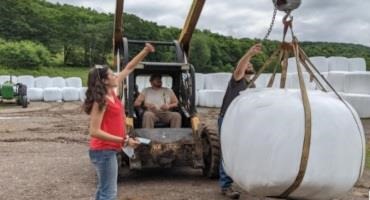
Anderson '23 on farm working with Delaware County CCE extension specialists. Photo by Dale Dewing, Delaware County CCE nutrient management program senior team leader.
What have you learned during your summer internships with Delaware County CCE?
We’re working on a project studying whole-farm nutrient mass balances, so we’re looking at all the nutrients coming onto farms, how they cycle through and how they leave farms. At CCE we go out on farm visits to collect soil samples and other information needed for the annual assessments. I input the data, and then Agustin Olivo, Ph.D. student on the project, runs a progress report that shows how the farm is doing: if they’re not using enough fertilizer and depleting their soil resources, or if they’re using more than is needed, which costs farmers money and could pose a risk for the environment. Then we go back to the farm and discuss the results with them and suggest some tweaks to their management plans.
I was working with four organic and/or grass-fed dairies to see how their management impacts nutrient cycling and soil health. I went back 30 years into the soil test database and pulled every soil sample we have for these four farms, to see how phosphorus levels have changed over time.
Another part of the project is looking at farms’ carbon footprints using the Cool Farm Tool, an online calculator that helps farmers assess greenhouse gas emissions, water use and biodiversity. The tool has mostly been used in Europe, so we’re trying to see if it can be used here in New York.
I’ve learned a lot about the scientific method, about different management strategies to help farmers maintain productivity and soil health without overfertilizing, and a lot about myself and my future career goals. For me, the hands-on experience I’ve gained has been really valuable.
Source : cornell.edu