Bioplastics — biodegradable plastics made from biological substances rather than petroleum — can be created in a more economical and environmentally friendly way from the byproducts of corn stubble, grasses and mesquite agricultural production, according to a new study by a Texas A&M AgriLife Research scientist.
This new approach involves a “plug-in” preconditioning process, a simple adjustment for biofuel refineries, said Joshua Yuan, Ph.D., AgriLife Research scientist, professor and chair of Synthetic Biology and Renewable Products in the Texas A&M College of Agriculture and Life Sciences Department of Plant Pathology. These “plug-in” technologies allow for optimization of sustainable, cost-effective lignin — the key component of bioplastics used in food packaging and other everyday items.
The $2.4 million project is funded by the U.S. Department of Energy’s Energy Efficiency and Renewable Energy Bioenergy Technologies Office. The research has recently been published in Nature Communications.
Yuan and researchers are submitting next-phase requests for additional project funding.
An adaptable process
Efficient extraction and use of lignin is a major challenge for biofuel refineries, Yuan said.
“Our process takes five conventional pretreatment technologies and modifies them to produce biofuel and plastics together at a lower cost.”
Yuan’s research builds on previous work investigating enhanced extraction methods for lignin.
The new method, named “plug-in preconditioning processes of lignin,” or PIPOL, can be directly added into current biorefineries and is not cost prohibitive, Yuan said. PIPOL is designed to integrate dissolving, conditioning and fermenting lignin, turning it into energy and making it easily adaptable to biorefinery designs.
Bioeconomy ‘a federal priority’
Yuan said the bioeconomy and biomanufacturing sectors are a federal priority as the White House Office of Science and Technology Policy points to bioeconomy infrastructure, innovation, products, technology and data to enhance U.S. economic growth.
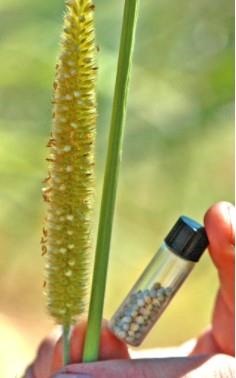
A high-yielding perennial sorghum forage hybrid can be used as a feedstock to create bioplastics in a more economical and environmentally friendly way.
The bioeconomy supports some 285,000 jobs and generates $48 billion in annual revenue.
“Innovation is the key to achieving growth and a more widespread use of biodegradable plastics. Lignocellulosic biorefinery commercialization is hindered by limited value-added products from biomass, lack of lignin utilization for fungible products and overall low-value output with ethanol as primary products,” he said. “This recent discovery will make significant strides to overcome some of these challenges.”
Yuan also touted the research for its environmentally friendly aspects.
“We are producing over 300 million tons of plastics each year,” he said. “It’s critical to replace those with biodegradable plastics. This work provides a path to produce bioplastics from common agriculture waste like [that from production of] corn and other grasses and wood.
“We think this research is very industrially relevant and could only help enable the biorefinery and polymer industries to [attain] greater efficiencies and economic opportunity.”
The role of agriculture byproducts
AgriLife Research and the College of Agriculture and Life Sciences share a commitment to seek solutions through science to solve environmental challenges. Their research has already found that sustainable products such as mesquite and high-tonnage sorghum can be used as feedstock for biofuel production.
Agricultural byproducts such as corn stubble and other grasses are alternative feedstock sources for biofuel plants, Yuan said. These create potential new revenue streams for farmers as well as the transportation sector that transports harvested feedstock and byproduct crops to refinery operations.
“We have shown that bioplastics from lignocellulosic biorefineries can be more economically beneficial, which opens new avenues to use agricultural waste to produce biodegradable plastics,” Yuan said. “The discovery will mitigate global climate changes via replacing fossil fuel and nondegradable plastics by renewable and biodegradable plastics.”
Source : tamu.edu