By Mike Loizzo
The use of cover crops between growing seasons can improve nutrient cycling and soil health among other things. Researchers in the UF/IFAS soil and water sciences department (SWS) conducted a study on the benefits of a summer cover crop in organic vegetable production. Specifically, they were looking at how it impacts nitrogen cycling.
“We established a two-year experiment comparing the effects of five summer cover crop treatments on cover crop biomass production, soil nitrogen cycling, and yields of organic vegetables,” explained John Allar, who received his master’s degree in SWS in 2020. The study was part of his thesis research.
“The goal was to see how beneficial cover crops could be for organic vegetable producers who don’t have many affordable options to meet the demand for nitrogen with certified organic products,” he added.
The five cover crop treatments used were:
- A monoculture of Sunn Hemp (SH)
- A monoculture of Sorghum sudangrass (SSG)
- A mixture of SH and SSG
- A mixture of SH, SSG, and buckwheat
- A mixture of SH, SSG, buckwheat, cowpea, and sunflower
Additionally, there was a weedy fallow control plot with no planted cover crops. The planting regimen was summer cover crops, a bell pepper crop, winter rye, and then acorn squash. The second year included a summer cover crop followed by bell peppers. The experiment took place at the UF Field and Fork Farm and Gardens.
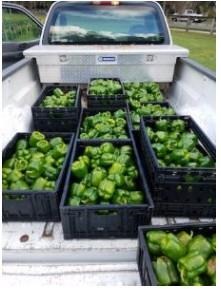
A green pepper harvest from 2018.

John Allar standing with plots of cover crops behind him in 2019.
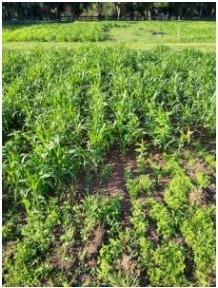
A plot of cover crops – Sunn hemp and sorghum sudangrass – in 2019.
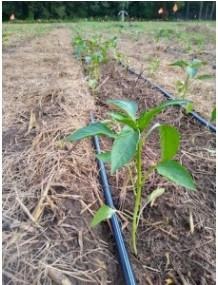
Green pepper plants after transplanting in 2019.
Results
Summer cover crop mixtures generally produced more biomass than monocultures, with the two-species and five-species mixtures having the highest biomass and nitrogen uptake, respectively. However, there was no consistent increase in soil nitrogen availability or cash crop yields in cover-cropped treatments.
“Our findings highlight the need to better quantify nitrogen release from cover crop residues,” Allar said. “Also, further investigation is needed to improve the management of cover crop nitrogen from alleys in vegetable production systems with wide row spacing. These cover crops contain a lot of nitrogen in their biomass, and better utilizing those nutrients across the whole field would allow producers to reduce external inputs while maintaining, if not improving, crop productivity and soil health.”
Still, the study’s results are being used now. James Longanecker, farm manager at Field and Fork, said the data has been used for other research projects including ginger, turmeric, and peanuts.
“Thanks to John’s research, we’re able to replace a cycle of compost that we used to purchase to increase our soil organic matter,” Longanecker explained. “It makes sense to grow our own inputs and it’s satisfying to know that the mixes we choose are backed up by science.”
Source : ufl.edu