By Bethany Johnston and Aaron Berger
Have you wanted to have more calves born earlier in your calving season, but did not want to deal with the increase in labor, cost and facilities to utilize estrus synchronization and artificial insemination? The protocol shown (Figure 1.) can increase the number of cows coming into estrus early in the breeding season, with one time through the chute, one injection, and breeding using only natural service.
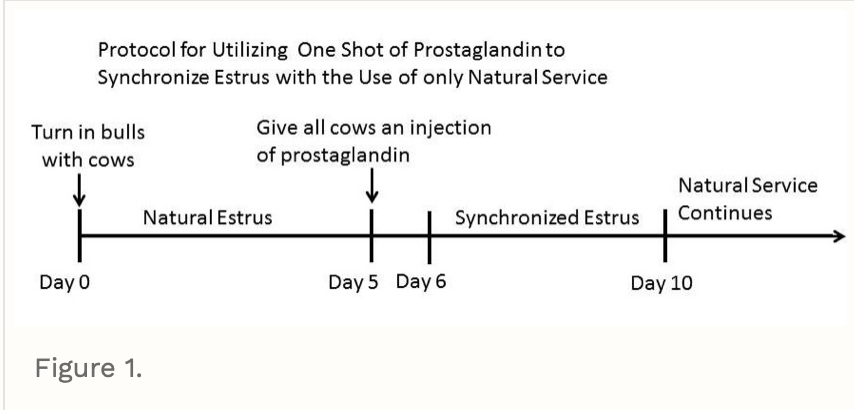
This protocol calls for bulls to be turned out with the cows on Day 0. On Day 5, cows are given a shot of prostaglandin (PGF2α) which synchronizes a majority of the cows to be in heat/estrus from Day 6 through Day 10. The injection of prostaglandin causes any cows with a corpus luteum present on one of their ovaries to regress, ceasing progesterone production. This then triggers the cows to come into heat/estrus.
If the cow conceives during Day 1 to 5, she will not abort when given the prostaglandin injection on Day 5 because the developing corpus luteum at the site of ovulation on the ovary has not yet reached maturity and will not respond to prostaglandin.
Research conducted at the Fort Keogh Research Center near Miles City, Montana utilized this protocol over a three year period, achieving pregnancy rates over 85% in a 32-day breeding season. Research from the University of Nebraska showed 75% of cows calved in the first 21 days of the calving season utilizing this estrus synchronization protocol as compared to only 63% of cows from non-synchronized natural service breeding.
Utilizing natural service with this method of estrus synchronization will require adequate bull power. A bull to cow ratio of 1:15 with yearling bulls or 1:25 with mature bulls should be sufficient. Because early breeding and the synchronized estrus is occurring over a 10 day period, fertile and active bulls with adequate libido should be able to handle the number of cows that will be coming into heat. Breeding bulls should undergo a breeding soundness exam prior to the breeding season.
Producers considering the use of this synchronization tool should remember that a number of factors affect pregnancy rate including cow body condition score, plane of nutrition, cattle health, and bull fertility.
Estrus synchronization can shorten the calving season. The article “Use of Natural Service Sires with Synchronized Estrus” highlights other advantages of estrus synchronization and natural service.
Source : unl.edu